



An evidence-based look at inflammation, cartilage biology, and the role of natural supplements for joint health.
What Helps With Stiff Joints?
Stiff joints are typically driven by three underlying factors: lingering low-grade inflammation, gradual alterations in cartilage structure, and reduced muscle recovery. The most effective strategies support all three:
• Regulating inflammatory signaling
• Supporting cartilage matrix integrity
• Improving muscle recovery and oxidative resilience
When these systems are addressed together, joint mobility and comfort tend to improve more meaningfully than when only one pathway is targeted. That’s why a multi-pathway supplement like AlgaeCal Restore™ makes sense clinically.
Most people treat joint stiffness like a minor annoyance. Something you can stretch out, ice away, or just “push through.” But biologically, stiffness is not a surface problem. It reflects changes occurring within the joint environment itself.
Think about what a truly healthy joint needs to stay smooth, flexible, and pain-free:
- Cartilage that stays plump and hydrated, acting like a shock-absorbing cushion.
- Synovial fluid that flows freely to lubricate and nourish that cartilage.
- Inflammation that flares up when needed, and resolves promptly once the job is done.
- Strong surrounding muscles that evenly distribute force, so no single spot takes a beating.
When stiffness develops, it is usually because one or more of these processes has become less efficient. Inflammatory signals linger a little longer than they should. Cartilage loses some of its water-holding power. Collagen renewal slows down. Oxidative stress builds up in the tissues.
These shifts are gradual. They reflect biology adapting to age, stress, activity patterns, and nutritional status. And because stiffness arises from multiple overlapping influences, it rarely responds well to a single intervention.
Among these overlapping influences, one stands out for its consistency in the research: low-grade inflammation.
The Inflammatory Component of Stiff Joints
Inflammation is not inherently harmful. It is part of the body’s repair system. When joint tissue experiences mechanical strain, inflammatory signals recruit cells to remove damaged proteins and begin rebuilding.
In a healthy system, that response is temporary. Cytokines rise, repair occurs, and signaling subsides.
But with age, metabolic stress, or inadequate recovery, this resolution phase becomes less efficient. In population studies1 of older adults, circulating levels of pro-inflammatory cytokines such as IL-6 and TNF-α tend to be modestly but consistently elevated, even in the absence of acute injury, and these elevations correlate with reduced physical function and chronic disease risk.
IL-6 in particular is often used as a marker of low-grade systemic inflammation in aging research2, and elevated levels have been associated with joint degeneration and mobility decline.
These findings help explain why inflammatory signals can linger and influence the joint environment. Not in dramatic spikes like infection, but in subtle, persistent elevations that shape tissue biology over months and years.
This persistent low-grade inflammation adversely affects cartilage hydration and the function of chondrocytes –– the cells responsible for producing cartilage. Over time, this can reduce the tissue’s ability to retain water and recover after load, contributing to the sensation of stiffness.
Stiffness, then, is rarely the result of completely worn-out structures. More often, it reflects a joint environment in which inflammatory signaling does not fully resolve. When resolution falters, cartilage resilience gradually declines.
Understanding this distinction is important. The goal is not simply to suppress joint discomfort. It is to support the biological processes that allow inflammation to rise appropriately, resolve efficiently, and maintain a joint environment conducive to long-term tissue health.
Supporting Inflammatory Resolution
If persistent low-grade inflammation contributes to joint stiffness, then supporting proper inflammatory resolution becomes a logical intervention.
Curcumin has been studied3 for decades in this context. It is the primary polyphenol found in turmeric and has demonstrated regulatory effects on several inflammatory pathways, including NF-κB signaling, COX-2 expression, and cytokines such as IL-6 and TNF-α.
What makes curcumin particularly relevant is not that it suppresses inflammation indiscriminately. Rather, it appears to help modulate the duration and intensity of inflammatory signaling. In other words, it may support a more appropriate on-and-off inflammatory response.
The challenge historically has been bioavailability. Standard curcumin is absorbed poorly. Plasma levels after oral ingestion are typically low, which limits its systemic impact. This has been documented repeatedly in pharmacokinetic analyses4.
Theracurmin® was developed specifically to address that limitation. It is a nanoparticle dispersion form of curcumin designed to significantly increase absorption compared to conventional preparations. Published data5 indicate substantially higher plasma concentrations following ingestion, allowing more of the compound to reach systemic circulation.*‡
Why is this distinction important?
If a compound cannot reach meaningful levels in the bloodstream, its biological potential remains theoretical. Improved absorption allows its regulatory effects on inflammatory signaling to become clinically relevant.
In a randomized, double-blind, placebo-controlled trial6 conducted in adults over 40 with mild-to-moderate knee osteoarthritis, 180 mg of Theracurmin® daily for eight weeks was associated with improvements in knee pain and daily function, along with reduced reliance on NSAIDs.*‡
Why is the reduction in NSAID use seen with Theracurmin® so important?
NSAIDs reduce pain short-term but actually increase cartilage damage primarily by inhibiting the synthesis of proteoglycans and collagen, essential components for cartilage repair. NSAIDs suppress chondrocyte proliferation and long-term use accelerates joint degeneration7.
Given Theracurmin’s® double benefit, it’s not surprising that longer-term follow-up studies7 extending to six months reported sustained improvements in pain scores, mobility, and functional assessments, with a majority of participants classified as clinically improved.*‡
From a biological perspective, these findings are consistent with what we would expect if inflammatory signaling becomes better regulated within the joint environment.
This is why the inclusion of Theracurmin® in AlgaeCal Restore™ stood out to me. It addresses one of the central drivers of stiffness at the signaling level, rather than simply masking discomfort while damaging cartilage.
However, inflammation is only one dimension of joint aging. Cartilage structure and mechanical recovery capacity also require attention.
The Structural Side Of Joint Stiffness
Inflammation plays a major role in how joints feel day to day. But it’s not the whole story. Even when inflammatory signals quiet down, many people still notice that familiar creak or resistance. That’s because stiffness has a structural component too: the architecture of the cartilage itself begins to change over time.
Healthy articular cartilage, the smooth, glistening layer that caps the ends of bones, isn’t just passive padding. It’s a living, dynamic tissue built mostly from type II collagen fibers and proteoglycans (large molecules that act like molecular sponges). Together, they form a tightly organized matrix that traps and holds water under pressure. That trapped water is the secret to cartilage’s magic: it lets the tissue compress like a high-performance shock absorber, then spring back and evenly distribute load across the joint surface with almost no friction.
In a young, well-supported joint, this system stays in near-perfect balance. Specialized cells called chondrocytes constantly monitor the matrix. They break down tiny amounts of old or damaged material and replace it with fresh collagen and proteoglycans. Keeping everything resilient, hydrated, and ready for the next step, squat, or carry.
But over decades of use, and especially under repetitive mechanical stress, this delicate balance starts to tip. Matrix-degrading enzymes become more active. Collagen fibers turn over more slowly. Proteoglycan levels gradually drop. The matrix loses some of its ability to hold onto water as tightly as before. In other words, the cartilage begins to break down.
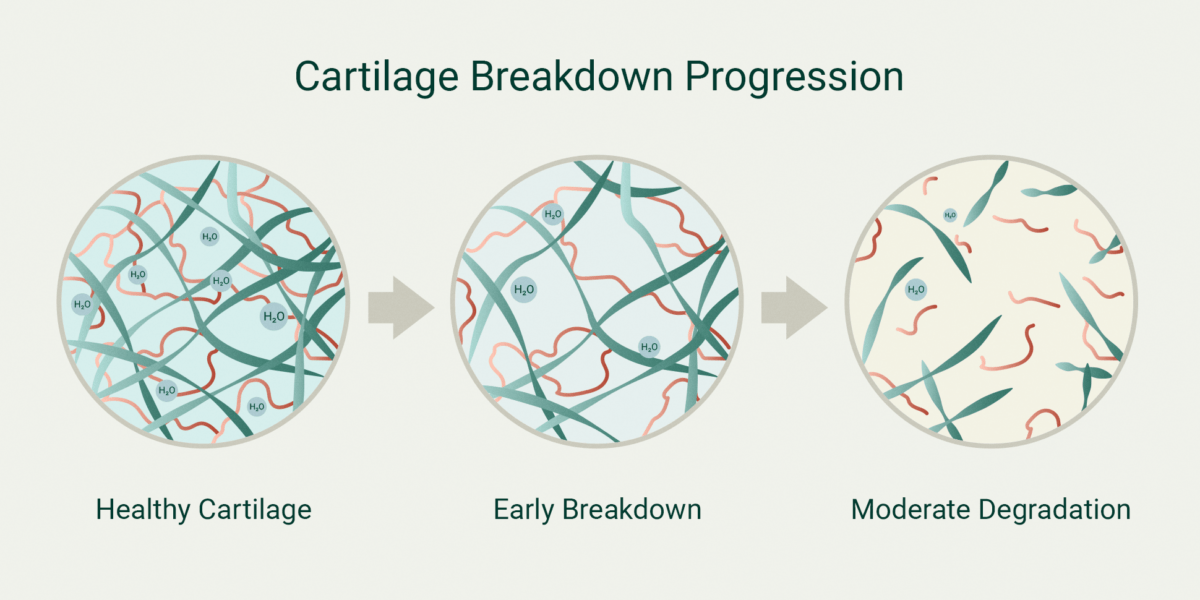
This breakdown is subtle and cumulative:
- Cartilage becomes a little less elastic.
- It holds slightly less water.
- It recovers a fraction more slowly after being compressed.
On their own, these are barely noticeable. But together, they transform how the joint responds to everyday movement. That smooth glide starts to feel a bit resistant. Loading the joint (even during normal activities) produces more “awareness” because the cushion isn’t rebounding quite the way it used to.
This is the structural reality behind stiffness.
Supporting the Structural Foundation of Your Joints
If stiffness comes from gradual, cumulative changes deep inside the cartilage matrix, then the smart next move isn’t just to quiet symptoms. It’s to actively support the cartilage’s structural integrity so it can better withstand everyday life.
That’s why I was excited to see that AlgaeCal Restore™ includes an ingredient called Move3®. A patented combination of two powerful, naturally derived ingredients: NEM® (natural eggshell membrane) and high-quality marine omega-3 fatty acids. Together, they target both the building blocks of cartilage structure and the inflammatory signals that can quietly accelerate breakdown under repeated stress.*‡
Natural eggshell membrane is fascinating because it’s packed with compounds that mirror what’s already in your joint cartilage: type I collagen, elastin, glycosaminoglycans (GAGs like chondroitin and hyaluronic acid), and other key matrix elements. These are the very raw materials and signaling molecules chondrocytes use to maintain, repair, and rebuild the cartilage framework day after day.
The marine omega-3s add a complementary layer. They help moderate the processes that can tip cartilage into faster degradation when joints face ongoing mechanical load.
But here’s what truly sets Move3® apart: it wasn’t just tested on how people feel. It was rigorously evaluated on what’s actually happening inside the cartilage. At the molecular level.
In a gold-standard, randomized, double-blind, placebo-controlled human trial8, researchers recruited 85 healthy adults aged 40–70 and put their joints through a real-world challenge: two full weeks of daily StairMaster sessions. (If you’ve ever done high-rep stair climbing, you know exactly how unforgiving that is on knees and hips.)
They tracked joint discomfort and stiffness. Which you’d expect in a joint study. But they also measured urinary CTX-II, a well-validated biomarker that directly reflects the breakdown of type II collagen, the primary structural protein in cartilage.
When uCTX-II levels rise, it means cartilage is being degraded faster than it’s being rebuilt. That’s a clear sign of structural stress tipping toward wear. When levels drop, it signals the joint has shifted into a more protective, preservation mode.
The results were striking:
- After just one week, participants taking Move3® showed a 12.9% reduction in uCTX-II compared to baseline.*‡
- After two weeks, that dropped further to a 17.7% reduction.*‡
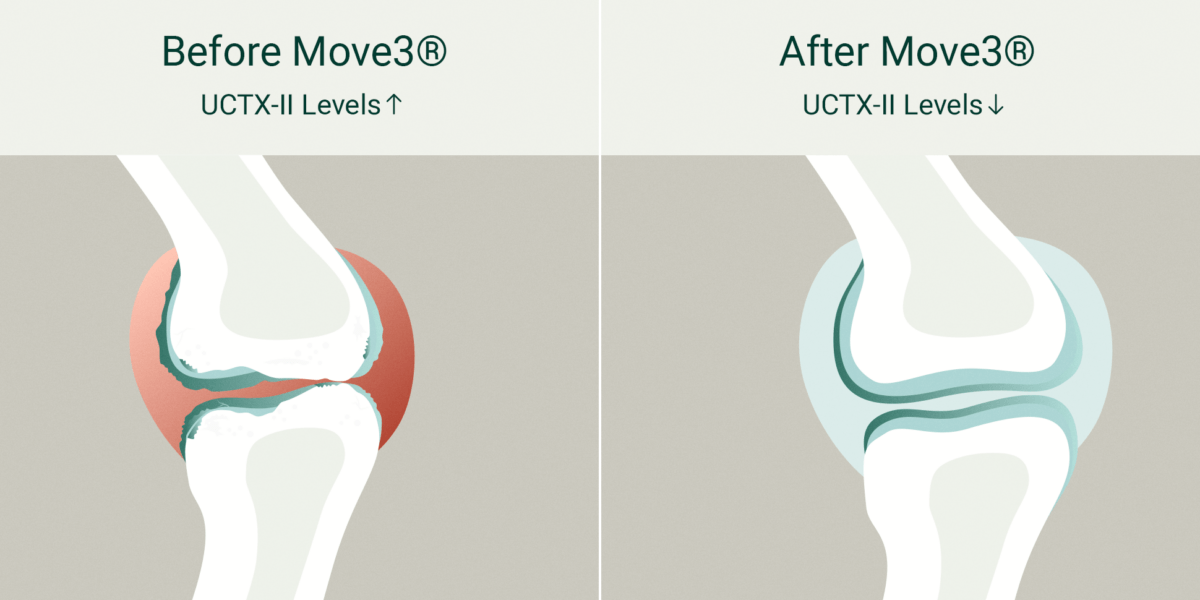
All while they kept up the same intense stair routine.
At the same time, they reported meaningful improvements: joint pain eased by about 32% after week one and 41% after week two, with stiffness dropping noticeably too.*‡
This is clinically significant!
Most joint formulas aim to make you feel better while breakdown quietly continues underneath. Move3® delivered both: measurable relief and a clear reduction in cartilage breakdown markers, even under continued mechanical stress.
From a biological perspective, this fits perfectly with the structural story of stiffness. When matrix-degrading activity slows and the cartilage environment is better protected, hydration stays higher, elasticity rebounds faster, and that post-activity “creak” starts to fade more quickly.
Move3® therefore pairs beautifully with Theracurmin®. One helps restore a cleaner inflammatory on/off rhythm. The other directly supports the cartilage matrix’s ability to resist and recover from the daily loads that would otherwise accelerate structural decline.
Of course, joints don’t operate in isolation. Even with strong cartilage and balanced inflammation, how well your surrounding muscles handle stress, and how quickly they recover, plays a huge role in whether joints feel youthful or “aged.” That brings us to the next piece of the puzzle: oxidative stress and muscle resilience.
The Muscle & Recovery Side of Joint Stiffness
Cartilage health and inflammatory balance are crucial, but joints never work in isolation. Every time you take a step, squat to pick something up, climb stairs, or even stand from a chair, the muscles around that joint are doing the heavy lifting. Literally!
Strong, resilient muscles act like built-in shock absorbers and stabilizers. They absorb and distribute force, keep alignment precise, and dramatically reduce peak stress on the cartilage surfaces below. When muscle performance starts to slip, more mechanical load gets transferred straight to the joint itself.
And that’s where things get interesting (and frustrating) as we age.
During any physical effort, your muscles naturally produce reactive oxygen species (ROS). These are short bursts of oxidative stress that are part of how energy is made and adaptation happens. In a younger or well-supported system, powerful antioxidant defenses mop this up quickly. Muscle fibers reset, inflammation resolves, and you’re ready to go again with minimal “payback.”
But over decades, that cleanup process becomes less efficient. Antioxidant capacity gradually declines. Oxidative stress accumulates a little more with each bout of activity. Muscle fibers stay in a mildly stressed state longer. Fatigue creeps in sooner. Recovery drags out.
The downstream effect on joints is direct and powerful:
- Muscles tire faster and absorb less force.
- Joint stability wavers slightly.
- More load lands squarely on cartilage, tendons, and joint surfaces.
So even if your cartilage hasn’t changed dramatically, it may no longer recover the way it once did. With age, chondrocyte numbers decline — reducing your joints’ ability to maintain and repair cartilage. At the same time, AGEs can build up within collagen, creating stiff cross-links that make cartilage less flexible and may further accelerate chondrocyte aging. In other words, your joints may be dealing with the same daily demands using tissue that is less resilient and less able to repair itself9.
That is when you start noticing the “I’m paying for this tomorrow” sensation after activities that used to feel normal. Stiffness lingers longer. Joints feel heavier, more worn, even when scans or markers show only modest structural shifts.
If oxidative stress and delayed muscle recovery contribute to joint strain, then supporting antioxidant capacity — and the cells that help maintain cartilage — becomes increasingly important as we age.
Supporting Muscle Recovery For Healthier Joints
If oxidative stress accumulates in muscle tissue and recovery becomes less efficient, joints are forced to absorb more mechanical load than they were designed to handle. Supporting antioxidant capacity is therefore not simply about reducing soreness. It is about preserving the muscular protection that joints depend on.
Astaxanthin has been studied extensively in this context.
Astaxanthin is a carotenoid antioxidant derived from microalgae. Unlike many antioxidants that remain largely in circulation, astaxanthin integrates into cell membranes, including those of skeletal muscle fibers and mitochondria. This allows it to influence oxidative stress at the cellular level, where fatigue and post-exertional damage originate.
The specific form included in AlgaeCal Restore™, AstaReal®, has been evaluated in multiple human clinical trials, often at low daily doses of 4–6 mg.
In a six-month, randomized, double-blind, placebo-controlled study9 in healthy adults, participants taking 4 mg of AstaReal® daily improved squat endurance by approximately 55 percent, compared to about 20 percent in the placebo group. No additional training protocol was introduced. The difference reflected improved muscular efficiency and recovery.*‡
In another randomized controlled study10 involving competitive athletes, supplementation with AstaReal® resulted in a 44 percent smaller rise in creatine kinase levels after intense exertion. Creatine kinase is a well-established marker of muscle fiber damage.*‡
From a joint-health perspective, these findings are relevant.
When muscle tissue resists fatigue longer and sustains less oxidative damage, it maintains more stable force absorption. Alignment remains more precise. Mechanical stress is distributed more evenly across the joint surface rather than concentrated in isolated areas.
This reduces cumulative strain on cartilage and connective tissue over time.
Astaxanthin does not directly rebuild cartilage, and it does not primarily regulate inflammatory signaling. Its contribution is different. It helps preserve the muscular resilience that protects the joint during repeated load.
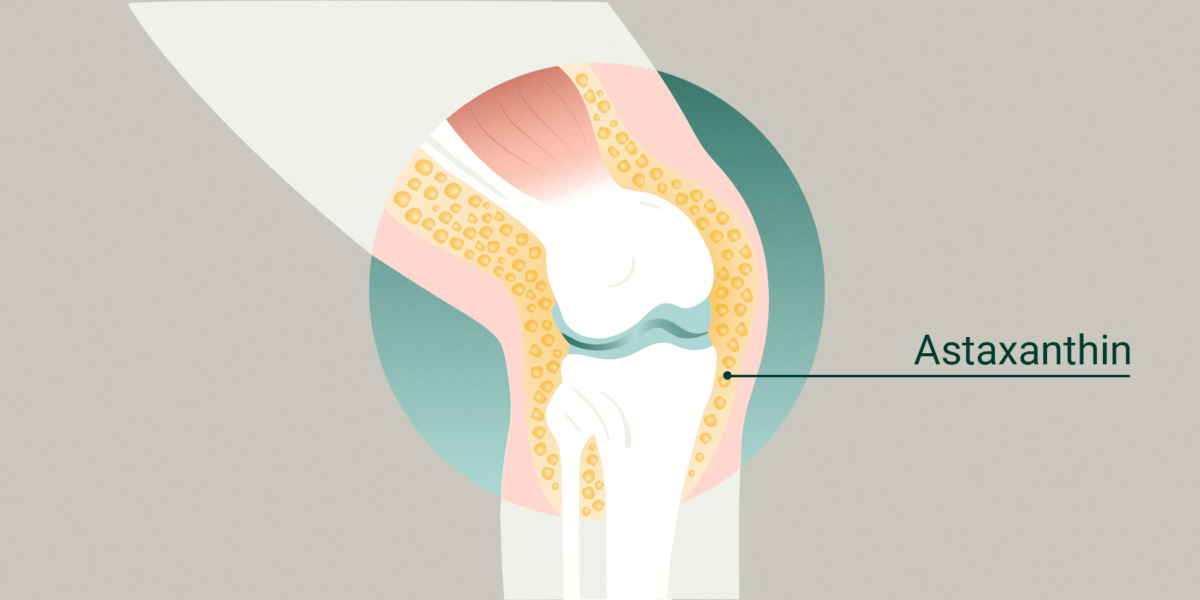
When inflammatory regulation, cartilage structure, and muscle recovery are addressed together, the joint environment improves in a meaningful way. Movement becomes less costly. Recovery becomes more complete. And stiffness becomes less persistent.
The Best Supplement For Joint Health?
Joint stiffness isn’t usually the result of one isolated problem. It’s the accumulation of three interconnected shifts happening inside your body:
- Inflammatory signals that don’t fully resolve the way they used to.
- Cartilage matrix that slowly loses some of its hydration, elasticity, and repair speed.
- Muscles that recover more slowly from daily demands, shifting extra load onto the joints themselves.
Tackling just one of these layers, whether through an anti-inflammatory diet, collagen boosters, or muscle-support formulas, can bring temporary relief or modest improvement. But real, lasting change happens when you address all three together. When the signaling environment calms, the cartilage framework gets reinforced, and the muscular support system regains efficiency, the entire joint ecosystem starts working in harmony again.
That’s the guiding philosophy behind AlgaeCal Restore™.
- Theracurmin® helps restore a cleaner, more responsive inflammatory rhythm. So irritation doesn’t linger and cartilage isn’t constantly fighting low-grade stress.*‡
- Move3® directly supports the structural integrity of cartilage. Supplying matrix-building compounds and measurably slowing breakdown markers like uCTX-II, even under continued mechanical load.*‡
- AstaReal® strengthens muscle resilience. Reducing oxidative damage, improving endurance, and cutting post-activity muscle stress so joints experience less concentrated force day after day.*‡
No single magic bullet. Just a thoughtful, biology-first formula designed around human clinical research on the exact processes that drive joint aging and stiffness.
If you’ve been searching for a natural joint-health supplement that goes beyond surface-level “comfort” promises… one grounded in measurable outcomes from randomized, double-blind studies rather than flashy marketing… AlgaeCal Restore™ was created with people like you in mind.
We’re in the final stages of pre-launch right now. The first bottles are being prepared, and we’re opening priority access for those who want to be among the first to know when it’s available, along with exclusive launch pricing.
Click below to join the priority list and you’ll get a chance to buy it before it goes on sale to the general public.
Your joints have carried you this far. With the right support, they can carry you further. Smoother, stronger, and with far less reminders of every step.
Looking forward to hearing how it works for you.
Lara
‡Results consistent with Clinical Trials on Individual Ingredients.



Pat Strusinski
September 29, 2026 , 11:13 amcan I take your restore if I had a kidney stone? it probably could tains oxalates.