



An evidence-based guide to reducing joint pain, stiffness, and inflammation, and why bioavailability makes all the difference.
If you’ve been dealing with joint pain or stiffness, chances are you’ve heard the same advice more than once:
“Try turmeric.”
Maybe a friend mentioned it. Maybe you saw it in a wellness article. Maybe your pharmacist pointed you toward a bright orange bottle promising “joint support.”
And to be fair, the recommendation isn’t random.
Turmeric has been studied for decades for its role in supporting healthy inflammation levels. It contains a compound called curcumin. That’s the part of turmeric that researchers believe is responsible for most of its joint-related benefits.
And on paper, it sounds promising. For example, in one study1, researchers from The Journal of Medicinal Food examined 8 randomized clinical trials involving hundreds of participants with arthritis symptoms. They found that about 1,000 mg/day of curcumin significantly reduced pain and improved function compared to placebo, with effects similar to common over- the-counter pain medications.
Sounds good, right?
So you do what most people do, and order a curcumin supplement online.
And then… not much happens.
Your knees still feel stiff when you get up from a chair. Your hips still need a minute to “warm up.” Your shoulders still remind you they’re there when you reach overhead.
At that point, it’s easy to assume one of two things:
Either curcumin doesn’t really work. Or your joints are simply “getting older,” and this is just how it is now.
But here’s the part most people never get told…
The issue is not whether curcumin works. The issue is whether enough of it reaches your joints to make a difference.
Because while turmeric contains curcumin… it only makes up about 2–3% of the root by weight. And even purified curcumin, in its standard form, is absorbed extremely poorly by the body.
That’s why choosing the best curcumin for joint health isn’t about finding the brightest label or the highest milligram number.
It’s about understanding how curcumin actually works inside the body, and what determines whether it can meaningfully support joint comfort, stiffness, and long-term joint health.
So let’s start there.
How Curcumin Supports Your Joints

Joint discomfort doesn’t begin when you feel it. It begins long before that.
Inside every healthy joint is a smooth layer of cartilage. This smooth, shock-absorbing tissue allows bones to glide without friction. And it’s constantly being repaired by specialized cells called chondrocytes.
But that repair process is highly sensitive to inflammation.
Most people think that inflammation is bad. But it isn’t. In fact, it’s an essential part of your body’s repair system.
When you twist something in the garden… overdo it at the gym… or put unusual stress on a joint… inflammation switches on.
And you want it to switch on!
It rushes repair cells to the area.
Clears out damaged tissue.
Signals your body to fix what needs fixing.
Then, once the job is done, it switches off.
That’s how it’s supposed to work: on when needed, off when not.
But over the years, that clean on/off switch starts to get sticky. And inflammation doesn’t always shut off like it used to. Instead, it lingers at a low level. Not enough to notice as “swelling,” but enough to keep the joint irritated.
And that changes the joint environment…
People often describe it as “feeling stiff,” “feeling sore,” or “feeling old.”
But it isn’t age that’s doing the damage. It’s the effect of inflammation that never quite turns off.
This is where curcumin becomes clinically interesting.
In both laboratory and human research, curcumin has been shown to influence key inflammatory pathways, including NF-κB and COX-2, two biological switches that help determine how long inflammation remains active inside joint tissue.
Why does that matter?
Because NF-κB acts like a master control signal. When it stays active, it tells the body to continue producing inflammatory compounds. COX-2, in turn, helps generate substances like PGE2 – one of the molecules linked to joint sensitivity and stiffness.
In a landmark study2 published in Biochemical Pharmacology, researchers tested curcumin directly on human articular chondrocytes. Those are the cells responsible for maintaining joint cartilage. When those cells were exposed to inflammatory cytokines that mimic arthritic conditions, curcumin significantly reduced NF-κB activation. It also lowered COX-2 expression, decreased production of PGE2, and reduced levels of cartilage-degrading enzymes such as MMP-9.
In simple terms, curcumin helped quiet the signals that prolong inflammation, and reduced the biochemical activity that contributes to cartilage breakdown.
These findings aren’t isolated.
A comprehensive review3 published in Drug Design, Development and Therapy examined a wide range of laboratory, animal, and early human data. Across multiple models, curcumin consistently suppressed NF-κB activation in cartilage cells. It reduced COX-2, PGE2, MMPs, and inflammatory cytokines such as IL-1β and TNF-α — the very messengers known to keep joint tissue in a state of ongoing irritation.
Taken together, this research helps explain something important.
Curcumin doesn’t eliminate inflammation. It helps to regulate it!
In simple terms, curcumin appears to support a healthier on/off rhythm.
It helps inflammation do its job, and then stand down.
But none of this matters unless the curcumin you take can actually reach your bloodstream — and from there, your joints — in meaningful amounts.
And that’s where most supplements fail.
Why Most Curcumin Never Reaches Your Joints
If curcumin influences inflammation so effectively in laboratory and clinical research, a fair question follows…
Why do so many people take it… and feel very little?
The answer has less to do with whether curcumin works and more to do with whether it’s absorbed.
Curcumin, in its natural form, has two major limitations.
First, it is poorly soluble in water. Second, it is rapidly metabolized and eliminated by the body.
In practical terms, that means when you swallow standard curcumin, only a small fraction survives digestion, enters the bloodstream, and circulates long enough to reach joint tissue.
Even at doses as high as 1,000 milligrams per day, blood levels of conventional curcumin are often extremely low. In some pharmacokinetic studies4, researchers have struggled to detect meaningful circulating concentrations at all.
And that changes everything.
Because inflammation inside a joint is not influenced by how much curcumin sits in your stomach. It’s influenced by how much actually reaches the tissue.
A recent large methodological review5 examining over 170 peer-reviewed publications on curcumin found that curcumin shows impressive biological activity in controlled settings. But in its standard oral form, bioavailability is severely limited.
That’s why milligram numbers on a label can be misleading.
A capsule may say “1,000 mg.”
But if only a small percentage enters systemic circulation, the effective dose, the amount your joints actually see, may be far lower.
And this is where many supplements fail. They rely on curcumin’s reputation. But they never solve its delivery problem.
Which leads to the question that really matters:
If curcumin’s mechanism is strong… and its clinical promise is real… what happens when you improve its absorption?
That’s where the conversation changes!
When Curcumin Actually Reaches Your Joints
Over the past two decades, researchers have worked to solve curcumin’s bioavailability problem. The goal was simple:
Increase the amount of curcumin that survives digestion, enters circulation, and remains active long enough to reach joint tissue.
One of the most studied solutions is a highly bioavailable form of curcumin known as Theracurmin®.
Unlike conventional curcumin powder, Theracurmin® uses a unique dispersion technology that significantly increases absorption. In pharmacokinetic comparisons6, it has been shown to produce dramatically higher blood concentrations than standard curcumin.
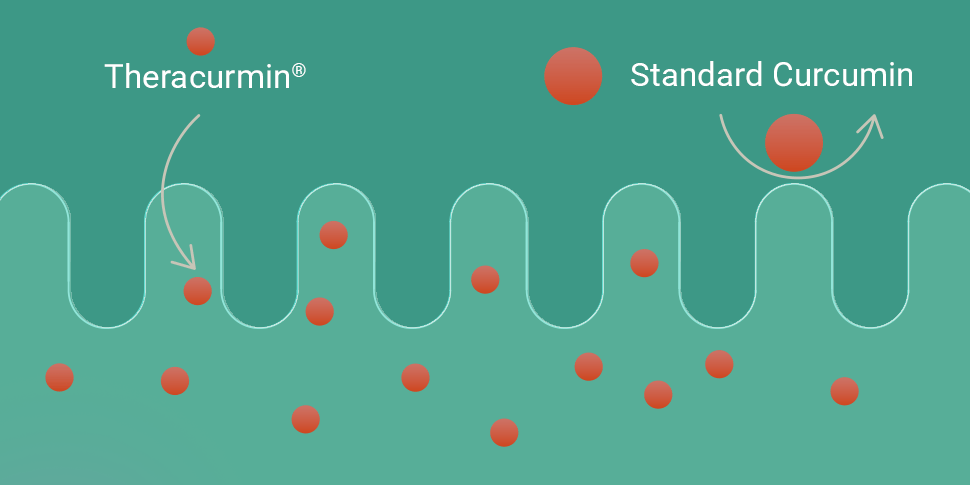
In practical terms, that means more of the compound reaches systemic circulation, and from there, the joints.
But absorption only matters if outcomes improve. And this is where the data becomes compelling.
In a randomized, double-blind, placebo-controlled study7 conducted at Kyoto Medical Center and published in the Journal of Orthopaedic Science, adults over 40 with mild-to-moderate knee osteoarthritis took 180 mg of Theracurmin® daily for eight weeks.
Researchers tracked knee pain, daily function, and reliance on nonsteroidal anti-inflammatory drugs.
By the end of the study…
Knee pain scores had significantly decreased.
Daily function improved.
And notably, participants reduced their use of NSAIDs (Nonsteroidal anti-inflammatory drugs).
That last point is crucial…
Because people don’t voluntarily reduce pain medication unless something underneath is improving.
It seems that when you solve curcumin’s absorption problem, it translates into measurable outcomes.
What to Consider When Choosing a Curcumin Supplement for Inflammation or Pain Relief?
If you’re looking for the best curcumin for joint health, here’s what actually matters.
1. Bioavailability
Curcumin is notoriously difficult for the body to absorb. In its standard form, very little survives digestion, enters circulation, and reaches joint tissue. That means a capsule can list “1,000 mg” on the label, and still deliver only a fraction of that where it counts.
Look for a clinically studied, bioavailable form of curcumin with published pharmacokinetic data showing improved absorption.
Without absorption, there is no effect!
2. Human Clinical Evidence
Curcumin has impressive lab data. But joints don’t live in test tubes. The most credible forms are those tested in randomized, controlled human trials measuring:
- Joint pain
- Stiffness
- Physical function
- Reduction in NSAID use
If a supplement uses a branded form of curcumin, check whether that exact form has published human studies behind it.
3. Curcumin, Not Just Turmeric
Turmeric root contains only about 2–3% curcumin by weight. So a capsule filled with raw turmeric powder may sound natural, but it may deliver very little of the compound responsible for inflammation regulation.
If your goal is joint support, look for standardized curcumin extract rather than generic turmeric.
4. Don’t Be Fooled By High Doses
More isn’t always better. Highly bioavailable forms often work at lower doses because more of the compound actually enters circulation. Extremely high doses of generic curcumin can sometimes signal poor absorption, not superior strength.
The real question isn’t:
“How many milligrams am I taking?”
It’s:
“How much is reaching my joints?”
5. A Formula That Reflects Joint Biology
Inflammation is only one part of the picture. Cartilage turnover, oxidative stress, and recovery from mechanical stress all influence how joints feel over time. The best joint health supplements are built around how joints actually age, not just around a single trendy ingredient.
Joint Support Built Around Biology

Curcumin plays an important role in regulating the inflammatory “on/off” rhythm inside your joints.
But inflammation is only one piece of the story.
If joint discomfort were driven by inflammation alone, a single ingredient might be enough.
But it isn’t!
Cartilage turnover matters.
Mechanical stress matters.
Oxidative damage during activity matters.
And once you understand that, the conversation widens.
That’s why serious joint support can’t rely on a single ingredient, no matter how well studied.
For example:
Move3®, a patented combination of natural eggshell membrane (NEM®) and premium-grade omega-3s,has been shown in human trials8 to:
- Reduce knee pain by up to 67%*‡
- Lower stiffness by nearly 29%*‡
- Decrease markers of cartilage breakdown in as little as two weeks*‡

That’s not just symptom relief. That’s measurable change inside the joint environment.
Then there’s AstaReal®, a clinically supported form of astaxanthin, shown to9:
- Improve muscle endurance by up to 55% over six months*‡
- Reduce post-exercise muscle damage by 44%*‡
- Support better recovery after physical stress*‡
Because when the muscles surrounding a joint recover better, they absorb force better. And when they absorb force better, joints aren’t left carrying the burden alone.
Taken together, these ingredients reflect something simple…
Joints don’t “wear out” for one reason. They change because multiple systems slowly drift out of balance.
Inflammatory signaling lingers longer than it should…
Cartilage turnover slows…
Muscles recover less efficiently after stress…
Oxidative strain accumulates…
Most supplements address one of those factors. But few address them together. And when they do, they often rely on generic forms, unclear dosing, or ingredients that haven’t been tested in meaningful human trials.
That’s why assembling clinically supported ingredients, in their studied forms, at relevant clinical doses, working in concert, has been far more difficult than it sounds.
Until now, no one has brought these clinically supported ingredients together, in their studied forms, at meaningful doses, inside a single joint formula.
We have.
Coming Soon. AlgaeCal Restore™
Joint Support That Goes Beyond Temporary Relief.
Most joint products try to manage discomfort for a little while. But our newest product, AlgaeCal Restore™, was built to do more. The key ingredients help address the underlying drivers of joint pain and stiffness by supporting cartilage, a healthy inflammation response, and muscle recovery around the joint*‡.
Here’s what that looks like in real people:
- 67% less knee pain compared with placebo in just 8 weeks.10*‡
- Measurable reductions in activity-related joint pain in 1–2 weeks.11*‡
- 28.6% less stiffness within 2 weeks.12*‡
- 17.7% less cartilage breakdown in just 14 days, based on a key biomarker linked to cartilage wear.13*‡
- Nearly 30% improvement in joint function within 6 months.14*‡
- Reduced reliance on nonsteroidal anti-inflammatory drugs (NSAIDs) within 8 weeks.15*‡
That’s the difference between a formula designed to “help you cope,” and one designed to support healthier joints from the inside out.
Join our priority list
We’ve prepared carefully for the launch of AlgaeCal Restore™. But because this is a brand-new formula made with clinically supported ingredients sourced from leading innovators in places like Japan and Sweden, we expect strong demand early on.
That’s why we created a priority list.
Join now and we’ll send you your 20% OFF† discount code before AlgaeCal Restore™ goes on sale to the general public in October, so you can order early.
‡Results consistent with Clinical Trials on Individual Ingredients.
†Terms Apply



Renee Lane
September 15, 2026 , 9:49 amI am having hip pain. Do you think this medication will address that. Also, high doses of turmeric can cause liver damage. Is the same true for Curcumin? Is any research available pertaining to this and are there other side effects associated with these supplements?