


Key Summary
- FORTIGEL® is a patented formulation of bioactive collagen peptides, made by hydrolyzing collagen into smaller peptides, developed to support cartilage health and joint comfort, and it is one of four patented collagen ingredients in AlgaeCal Collagen.*
- In a 12 week clinical trial of 180 active adults, 5 grams of FORTIGEL® daily reduced knee discomfort during exercise significantly more than a placebo, and doctor assessments also showed greater improvement.*‡
- In a 12-week placebo-controlled trial of 154 adults with knee or hip discomfort during daily activities, 5 grams of FORTIGEL® daily was associated with less pain while walking, climbing stairs, and kneeling than placebo.*‡
- In a small pilot trial of 30 adults taking 10 grams of FORTIGEL® daily, an MRI estimate of proteoglycan content increased in parts of the knee cartilage by 24 weeks, while it decreased in the placebo group.*‡
Could a daily scoop of collagen help your knees feel more comfortable? Researchers have investigated FORTIGEL® using specialized cartilage scans. Here’s what they found.§
Imagine being able to look inside your knees to see whether a collagen supplement was making a difference.
That’s what researchers set out to investigate in a small clinical trial. Using specialized MRI scans, they tracked changes in the cartilage that cushions the knee joint. Their findings suggested improvements in cartilage composition in certain areas.
The collagen they studied? FORTIGEL®.
It’s one of the four patented collagen ingredients in AlgaeCal Collagen. And if your knees have started making stairs, long walks, or time in the garden less comfortable, it’s an ingredient worth getting to know.
FORTIGEL® has been studied for both joint comfort and cartilage health. But what makes it different from ordinary collagen? How much do you need? And what can you realistically expect?
Let’s take a closer look at the science, starting with what FORTIGEL® actually is.
What Is FORTIGEL®?
FORTIGEL® is a patented formulation of collagen peptides developed to support cartilage health and joint comfort.*
Let’s unpack that.
Collagen is a protein your body uses to give structure and strength to tissues, including cartilage. To make FORTIGEL®, collagen goes through a process called hydrolysis, which breaks the large protein into smaller pieces called peptides.
You’ll also see these described as bioactive collagen peptides. “Bioactive” means they can influence biological activity in the body. Researchers have investigated how these peptides may affect the cells responsible for maintaining cartilage.
FORTIGEL® has a specific peptide composition, and that formulation has been tested in human studies. For example, a 12-week clinical trial found that 5 grams daily reduced exercise-related knee discomfort more than a placebo.
That gives you something concrete to look for when choosing collagen for joints: a named ingredient, a studied dose, and research measuring the benefit you want.
How Does FORTIGEL® Support Your Cartilage?
Think of the cartilage in your knees as a firm, water-filled cushion. Every time you walk, climb stairs, or get out of a chair, it helps absorb pressure and lets the ends of your bones glide smoothly against each other.
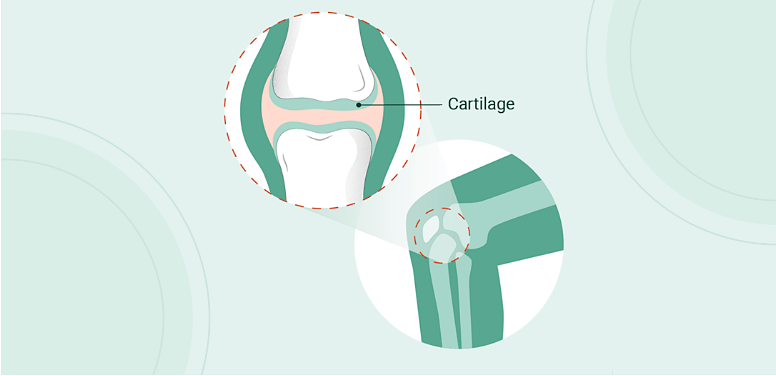
Two components help it do that job.
Collagen forms a strong framework. Within that framework sit molecules called proteoglycans, which attract and hold water. Together, they give cartilage its strength and ability to resist compression.*
Your body also has specialized cells called chondrocytes. Their job is to produce and maintain the materials that make up this cushion.*
Those cells are central to the science behind FORTIGEL®.
Laboratory research suggests that collagen peptides may encourage cartilage-maintaining cells to produce more of the tissue’s structural materials. In one cell-culture study, cartilage cells exposed to hydrolyzed collagen increased their production of type II collagen, the main collagen found in joint cartilage.
That offers a possible explanation for how collagen peptides could support cartilage from within.
But a laboratory experiment can only tell us so much. To find out whether taking FORTIGEL® makes a difference to people’s joints, researchers put it through human clinical trials.
Here’s what they found.
The Study That Looked Inside The Knee
Most joint studies ask people a fairly simple question:
Does it hurt less?
That matters, of course. But pain is subjective. One person’s “mild discomfort” is another person’s reason to avoid the stairs. So researchers at Tufts Medical Center and Harvard University tried something more ambitious.
They wanted to see whether taking FORTIGEL® could produce a measurable change inside the cartilage itself.
In this randomized, double-blind clinical trial, 30 adults were given either 10 grams of FORTIGEL® a day or a placebo for 48 weeks.
The researchers examined their knees using a specialized MRI technique called delayed gadolinium-enhanced magnetic resonance imaging of cartilage, or dGEMRIC for short.
These scans allowed them to estimate the amount of proteoglycan inside the participants’ knee cartilage.
Remember, proteoglycans are the tiny molecules that attract water and help cartilage absorb pressure. The more successfully cartilage holds water, the better equipped it is to cushion the joint.*
After 24 weeks, the scans revealed a significant difference.
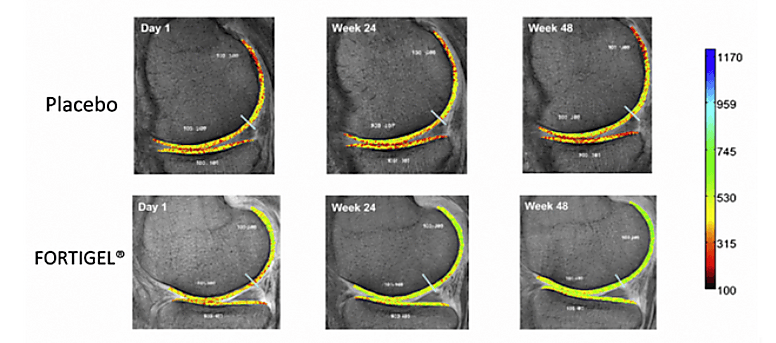
Proteoglycan levels had increased in parts of the knee cartilage in the FORTIGEL® group. In the placebo group, they had fallen.
If FORTIGEL® was changing what researchers could see on a scan, would people also notice a difference in how their knees felt?
Does FORTIGEL® Collagen Help With Knee Discomfort?
The MRI study showed that something was changing inside the knee.
The next question was more personal: Would people feel the difference?
Researchers at the University of Freiburg recruited 180 active men and women who regularly experienced knee discomfort during exercise.
These weren’t people recovering from a major injury. And they hadn’t been diagnosed with a joint condition. They were otherwise healthy adults whose knees complained when they ran, trained or played sports.
For 12 weeks, half took 5 grams of FORTIGEL® each day. The other half received a placebo.
Neither the participants nor the researchers examining them knew who was taking which.
At the beginning and end of the study, participants rated their knee pain on a 100-point scale. A doctor also examined each knee and gave an independent assessment.
The results agreed.
Exercise-related knee discomfort fell significantly more in the FORTIGEL® group than it did in the placebo group. The doctors’ assessments also found a greater improvement among those taking FORTIGEL®.*‡
And this happened with just 5 grams a day.
That dose matters. Plenty of collagen tubs boast about providing 10, 15 or even 20 grams per serving. But the number on the front tells you very little unless you know which collagen peptides are inside.
When choosing collagen for knee discomfort, look for the specific ingredient used in the research and the same daily amount tested in the trial.
But running and sport place unusual demands on the knees.
Could FORTIGEL® also help with everyday movements, such as walking, climbing stairs or getting down on one knee?
Researchers tested that too.
Can FORTIGEL® Help With Everyday Joint Discomfort?
You don’t have to be running a marathon to notice your knees. Sometimes it’s the ordinary movements that bring them to your attention. Walking to the stores. Climbing a flight of stairs. Getting up from a low chair. Kneeling to pull a weed and wondering how you’re going to stand again.
A clinical trial involving 154 adults looked at whether FORTIGEL® could make those everyday movements more comfortable.
The participants experienced discomfort in their knees or hips during normal daily activities. Half took 5 grams of FORTIGEL® each day. The other half took a placebo.
After 12 weeks, the difference was clear.
Compared with the placebo, people taking FORTIGEL® reported significantly less joint pain:
- At rest
- While walking
- While climbing stairs
- When kneeling down
They also found squatting easier.
And these improvements weren’t based solely on what participants reported. The doctors examining them also recorded significantly less pain at rest, during walking and while climbing stairs.
That makes this study especially useful for anyone looking for collagen for joint discomfort.
It suggests FORTIGEL® may help with the movements that determine how freely you live your day, from taking the stairs to getting down on the floor with your grandchildren.*
Once again, the amount used was 5 grams a day for 12 weeks.
And that gives us a surprisingly precise answer to the next question: how much FORTIGEL® should you actually take?
How Much FORTIGEL® Collagen Should You Take Per Day?
The most relevant FORTIGEL® studies used 5 grams a day. That was enough to reduce exercise-related knee discomfort in active adults. It was also the amount used in the study where people reported less pain while walking, climbing stairs and kneeling.
Both studies ran for 12 weeks.
The MRI trial used a larger 10-gram daily serving and detected changes in knee cartilage after 24 weeks. But you don’t need to assume that doubling the dose will double the benefit. Collagen peptides are studied as specific ingredients at specific amounts.
For joint comfort, 5 grams of FORTIGEL® a day is the clinically studied dose to look for.
You should also give it time.
FORTIGEL® isn’t designed to numb discomfort for a few hours. Its bioactive collagen peptides are intended to support the tissue inside the joint.* That process doesn’t happen overnight.
Based on the clinical research, a sensible expectation is:
- Around 12 weeks to assess changes in joint comfort*‡
- At least 24 weeks for measurable changes within cartilage*‡
Taking it every day matters more than taking it at a particular time. You can add FORTIGEL® collagen to coffee, a smoothie or another drink that fits easily into your routine.
There is one thing you should check before buying, however.
Make sure the product provides 5 grams of FORTIGEL® itself, rather than simply 5 grams of unspecified collagen.
AlgaeCal Collagen provides the full 5-gram clinical dose in every scoop.
Does AlgaeCal Collagen Contain FORTIGEL®?
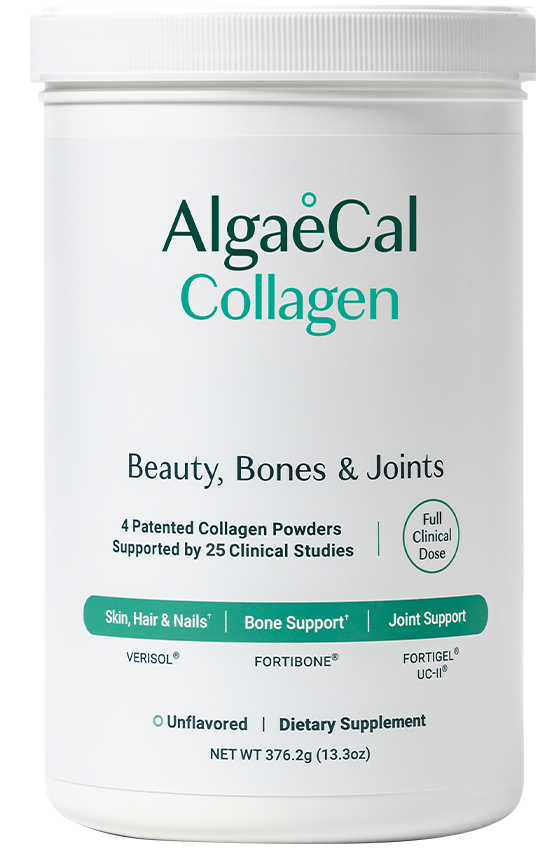
Yes. One scoop of AlgaeCal Collagen contains 5 grams of FORTIGEL®, the same daily amount used in the 12-week studies on exercise-related and everyday joint discomfort.
But FORTIGEL® is only one part of the formula.
Your knees aren’t the only part of your body that depends on collagen. Your bones, skin, hair and nails all need it too. And the collagen peptides studied for one tissue aren’t necessarily the ones studied for another.
That’s why AlgaeCal Collagen combines four patented collagen ingredients, each with a different job:
- FORTIGEL® supports cartilage and joint comfort.*
- UC-II® supports comfortable movement and joint flexibility.*
- FORTIBONE® supports the collagen framework inside your bones.*
- VERISOL® supports skin elasticity, smoother-looking skin, stronger nails and fuller hair.*
Each scoop provides the studied amount of all four: 5 grams of FORTIGEL®, 40 milligrams of UC-II®, 5 grams of FORTIBONE® and 2.5 grams of VERISOL®.

It’s an important difference! A tub may contain plenty of collagen and still tell you very little about what that collagen has actually been studied to do.
If joint comfort is your main concern, you can learn more about how collagen supports your joints and what may help with stiff joints.
‡Results consistent with Clinical Trials on Individual Ingredients. Results may vary.
§This content is for educational and informational purposes only and is not intended to diagnose, treat, cure, or prevent any disease or medical condition. It is not a substitute for professional medical advice. Always speak with a qualified healthcare provider about your symptoms, health concerns, and treatment options.


Article Comments