


Key Summary
- UC-II® is an undenatured type II collagen that keeps its natural structure intact and is thought to support joint comfort through immune tissue in the gut, not by supplying raw material.*
- In a 2022 randomized trial of 96 healthy adults aged 20 to 55 with knee discomfort during exercise, daily UC-II® for 24 weeks improved knee flexion by 3.23 degrees, versus 0.21 degrees for placebo.*‡
- In a randomized, placebo-controlled trial of 55 healthy adults with knee discomfort only during strenuous exercise, 40 mg of UC-II® daily for 120 days improved knee extension versus placebo (81° vs 74°).*‡ Average time to first discomfort rose from 1.4 to 2.8 minutes from baseline.*‡
- One daily scoop of AlgaeCal Collagen contains 40 mg of UC-II®, the amount used in the human clinical trials.
UC-II® is a unique form of undenatured type II collagen that works differently from collagen peptides. Here’s what that means for joint comfort and knee flexibility.*§
Nobody thinks about knee flexibility until they start losing it.
Then it turns up everywhere.
In the stairs you used to take two at a time. The low chair you now push yourself out of. That moment on the floor when you realize getting down was the easy part.
This is usually when people start looking for collagen for their joints. And the logic seems simple enough. Cartilage contains collagen. So take more collagen.
UC-II® doesn’t work like that. Most collagen supplements are broken down into tiny peptides that give your body raw materials it can use. But UC-II® takes a completely different approach.
It is a special form of undenatured type II collagen. “Undenatured” means its delicate three-dimensional structure has been kept intact. And that structure appears to be the secret to how it works. Instead of simply supplying more collagen, UC-II® communicates with immune tissue in the gut. This may help your body maintain a healthier response to the type II collagen already inside your joint cartilage.* In clinical studies, people taking UC-II® were able to bend their knees farther, move more comfortably and remain active for longer before discomfort set in.*‡
So how can collagen that begins its journey in your gut change what happens in your knees?
The answer is one of the more surprising stories in joint health research.
What Is UC-II® Collagen?
Most collagen powders contain hydrolyzed collagen. The collagen has been broken into small peptides, which your body digests and uses as raw material.
UC-II® is different in two important ways.
First, it is type II collagen. This is the form found mainly in cartilage, the smooth, springy tissue that covers the ends of your bones and helps your joints move without grinding against each other.
Second, UC-II® is undenatured. It is processed at low temperatures so that the collagen keeps its natural three-dimensional shape.
UC-II® comes from chicken sternum cartilage, which is naturally rich in type II collagen. This source may not sound glamorous, but it is the preserved structure of the collagen that makes the ingredient so interesting.
As researchers studying collagen for joint health have noted, hydrolyzed collagen and undenatured type II collagen are not simply two versions of the same supplement. They are processed differently and appear to work in different ways.
UC-II® is also a specific, patented ingredient. So a label that says “type II collagen” does not necessarily mean it contains UC-II® or the same collagen used in its clinical studies.
And the reason comes back to that awkward but important word: undenatured.
What Does “Undenatured Type II Collagen” Mean?
Think about what happens when you crack an egg into a hot pan. The clear egg white turns solid and white. It is still protein, but heat has permanently changed its structure.
That is denaturation.
Something similar can happen to collagen. Heat and certain manufacturing processes can cause its natural triple-helix structure to unravel. With hydrolyzed collagen, the protein is then broken into smaller peptides so it can be used as raw material by the body.
UC-II® is handled differently.
It is processed at low temperatures to preserve the collagen in its original form. This includes tiny features on its surface called epitopes, which the immune system uses to recognize the protein.
You can think of these epitopes as the identifying marks on the collagen. If its structure is pulled apart, those marks may be changed or lost. If the structure stays intact, the immune system can still recognize them.
This is why undenatured type II collagen is considered different from collagen peptides. One is broken down to provide smaller building blocks. The other keeps its shape because that shape is central to how it is thought to work.
Neither approach is automatically better. They simply have different jobs.
And UC-II® has a particularly unusual one: it appears to begin working not in your knees, but in your gut.*
How Does UC-II® Collagen Work?
Your gut has a difficult job. It must be ready to defend you against harmful bacteria, while allowing food to pass through without treating every mouthful as a threat.
To manage this, immune tissue in the gut constantly samples the proteins you eat. It learns which ones require a response and which ones can safely be tolerated. This process is known as oral tolerance.
Researchers believe UC-II® uses this existing system. When its preserved type II collagen reaches the small intestine, immune cells encounter its identifying features. This takes place partly in structures called Peyer’s patches, small areas of immune tissue in the gut. That contact is thought to encourage the production of regulatory T-cells. These cells act as part of the immune system’s braking system, helping to prevent an unnecessarily strong response.*
A review of type II collagen and oral tolerance describes how these regulatory cells may help the body maintain a more measured response to type II collagen elsewhere, including the collagen in joint cartilage.
UC-II® does not travel to your knees and coat them with new cartilage. Nor have human trials shown that it regrows cartilage. Rather it supports the immune response surrounding the cartilage already there.*
Much of the detailed evidence for this pathway comes from laboratory and animal research. Human trials answer a different, more practical question:
Does taking UC-II® actually help people move more comfortably?
Can UC-II® Collagen Improve Knee Flexibility?

The best way to answer that is to measure how far the knee can actually bend. That is what researchers did in a 2022 randomized, placebo-controlled clinical trial. The study involved 96 healthy adults between 20 and 55. None had been diagnosed with a joint condition, but all experienced knee discomfort during a repeated step-down exercise.
Half took UC-II® each day. The other half took a placebo. Neither the participants nor the researchers knew who was receiving which until the 24-week study had ended.
Knee movement was measured with a digital goniometer, an instrument that works rather like a protractor for the body. After 24 weeks, the UC-II® group could bend their knees an average of 3.23 degrees farther than when they started. The placebo group improved by just 0.21 degrees.*‡
The difference between the groups was statistically significant, and improvements in the UC-II® group were first detected after eight weeks.
The result was even more noticeable among participants over 35. In this smaller subgroup, knee flexion improved by 6.79 degrees with UC-II®, compared with 0.30 degrees with the placebo.
Subgroup findings should always be treated with more caution than the main result. Even so, the overall study found a measurable improvement in knee flexibility rather than relying on participants simply saying that their knees felt better.
Can UC-II® Help With Activity-Related Joint Discomfort?
Flexibility is useful to measure. But most people are more interested in how their knees feel when they use them. A 2013 clinical trial looked at 55 healthy adults who experienced knee discomfort during exercise. They had no joint pain while resting. It appeared only when they were put through a strenuous test on a step machine.
The participants took either UC-II® or a placebo every day for 120 days.
By the end of the study, average knee extension in the UC-II® group had improved to 81 degrees, compared with 74 degrees in the placebo group. The difference was statistically significant.
There were also signs that participants could exercise for longer before their knees began to bother them. Their average time before the first discomfort appeared doubled from 1.4 minutes at the beginning of the study to 2.8 minutes after 120 days.
So, when considered alongside the later 24-week study, the findings point in the same direction: UC-II® may help knees move more freely during physical activity.
UC-II® vs. Collagen Peptides: What’s the Difference?
UC-II® and collagen peptides may share the word “collagen,” but the body does not use them in the same way.
Collagen peptides have been hydrolyzed into small pieces. After digestion, these peptides and amino acids can be absorbed and used by the body. Certain bioactive collagen peptides may also signal cartilage-producing cells, called chondrocytes, to make more of the substances that form the cartilage matrix.
UC-II® keeps its natural structure intact. Rather than acting primarily as raw material, it is thought to work through oral tolerance and help regulate the immune response to type II collagen.*
Here is the simplest way to compare them:
| UC-II® | FORTIGEL® Collagen Peptides | |
| Form | Undenatured type II collagen | Hydrolyzed collagen peptides |
| Structure | Natural triple helix remains intact | Broken into smaller peptides |
| Proposed action | Works through the gut and immune system* | Provides bioactive peptides that act on cartilage cells* |
| Main research focus | Knee flexibility and joint comfort | Cartilage composition and activity-related joint discomfort |
| Daily amount studied | 40 mg | 5 g |
This helps explain why AlgaeCal Collagen contains both UC-II® and FORTIGEL®.
FORTIGEL® supplies specific collagen peptides studied for their effects on cartilage. UC-II® approaches joint support through a different biological pathway. One does not replace the other.
For anyone comparing collagen for joints, the ingredient name is more useful than the total number of grams on the label. It tells you which form of collagen you are getting, how it is expected to work and whether that exact ingredient has been studied in people.
How Much UC-II® Collagen Should You Take?
The human studies on UC-II® have used 40 mg once a day. That is much less than the several grams commonly found in collagen powders. But UC-II® is not intended to supply a large quantity of protein. Its preserved structure allows it to be recognized by immune tissue in the gut, so it is used in a much smaller amount.*
In the studies covered above, participants took 40 mg daily for either 120 days or 24 weeks. Improvements in knee flexibility were first detected after eight weeks in the longer trial.
It is also important to look for the UC-II® name on the label. The clinical research was conducted on this specific patented ingredient, not on every supplement described as chicken collagen or type II collagen.
And, as the study lengths suggest, UC-II® is not intended to produce an overnight change. The research points to daily, consistent use over several months.
Does AlgaeCal Collagen Contain UC-II®?
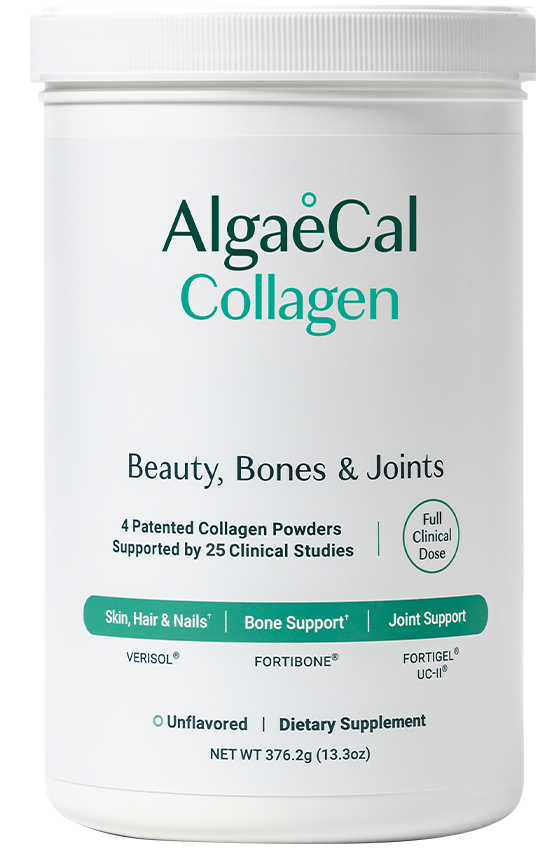
Yes. One daily scoop of AlgaeCal Collagen contains 40 mg of UC-II®, the same amount used in the human clinical trials.
It also contains 5 grams of FORTIGEL® collagen peptides. As we have seen, the two ingredients approach joint support differently. FORTIGEL® provides bioactive peptides studied for their effects on cartilage and activity-related joint discomfort.*‡ UC-II® retains its natural structure and is thought to work through oral tolerance.*‡
The formula also includes:
- 5 grams of FORTIBONE®, studied for its effects on bone density.*‡
- 2.5 grams of VERISOL®, studied for skin elasticity, wrinkles, hair and nails.*‡
Each is a named collagen ingredient included at the amount used in its clinical research.
This is important because adding more generic collagen does not automatically produce the same benefits. The form of collagen, the way it has been processed and the amount used in the research all need to match what appears on the label.
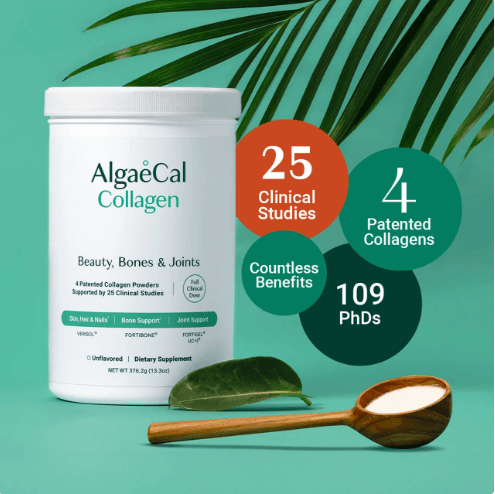
One daily scoop of AlgaeCal Collagen provides the studied amounts of both UC-II® and FORTIGEL® for joint support.*‡
‡Results consistent with Clinical Trials on Individual Ingredients. Results may vary.
§ This content is for educational and informational purposes only and is not intended to diagnose, treat, cure, or prevent any disease or medical condition. It is not a substitute for professional medical advice. Always speak with a qualified healthcare provider about your symptoms, health concerns, and treatment options.

Article Comments