



Why your knees sometimes hurt as you get older, and how to fix the real cause.
Knee pain usually doesn’t bother you when you’re lying in bed. It waits until you move, especially when you’re loading the joint.
That’s why you feel it when you squat to pick something up, walk down stairs, or head out for a 5K run.
That pattern isn’t random. It’s biology.
The knee is a high-compression joint designed to handle serious forces day after day.
- Walking: puts about 2–3 times your body weight through the knee1
- Descending stairs: 3–5 times body weight
- Deep squats or lunges: 5–8 times body weight
So if you’re 180 pounds, a deep squat can place over 1,400 pounds of pressure through your knees.
That sounds like a lot.
It is.
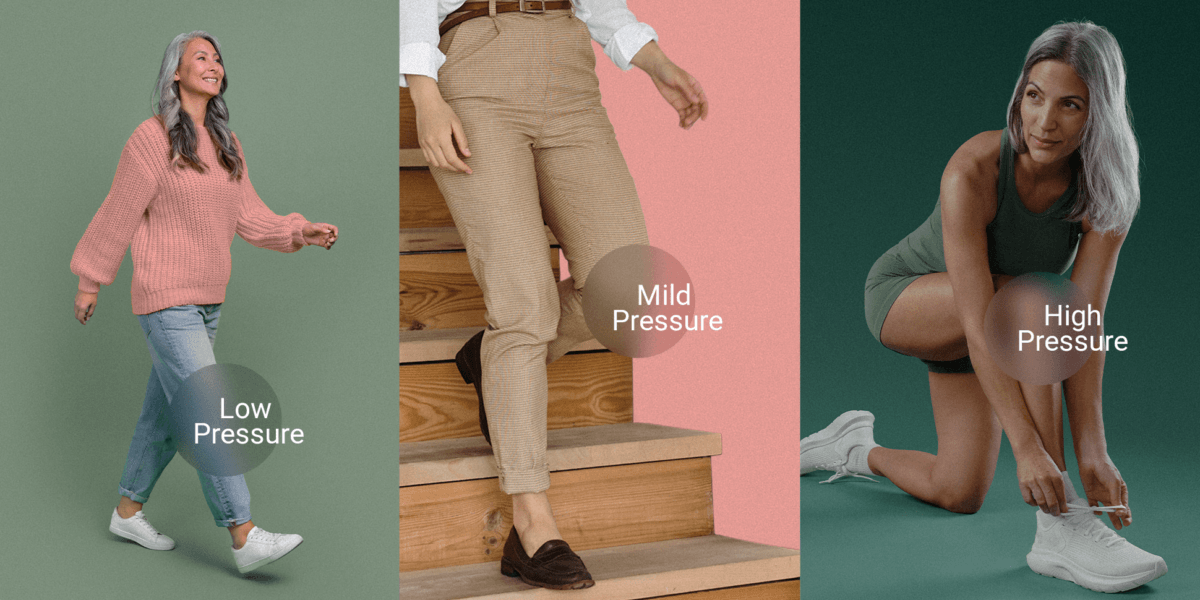
But when the joint is balanced and healthy, those forces pass through smoothly. Hydrated cartilage cushions and rebounds. Strong surrounding muscles absorb and distribute load evenly. Inflammation rises when needed and resolves quickly.
But over time, or due to injury, inactivity, nutritional shortfalls, or repetitive stress… small shifts happen:
- Cartilage loses a bit of its water-holding power, so it doesn’t cushion quite as effectively under pressure.
- Muscles fatigue sooner or recover more slowly, meaning more of that force transfers directly to the joint surfaces.
- Low-grade inflammation lingers longer than it should, making tissues more sensitive to compression.
That’s why knees tend to protest most during stair descent, deep squats, or downhill walking. These movements concentrate force where the joint is already under stress. And when the internal environment isn’t fully in sync, that concentrated load exposes the imbalance.
What’s Actually Inside Your Knee?
When people hear “knee pain,” they often imagine bone grinding on bone. But that’s not how a healthy knee is built.
At the ends of your thigh bone and shin bone sits a smooth, white layer called articular cartilage. It’s only a few millimeters thick, but it does an enormous amount of work.
This cartilage isn’t hard like bone. It’s more like a reinforced sponge.
It’s built from strong collagen fibers that form a framework. Inside that framework are large molecules called proteoglycans. Those molecules attract and hold water. A lot of it2.
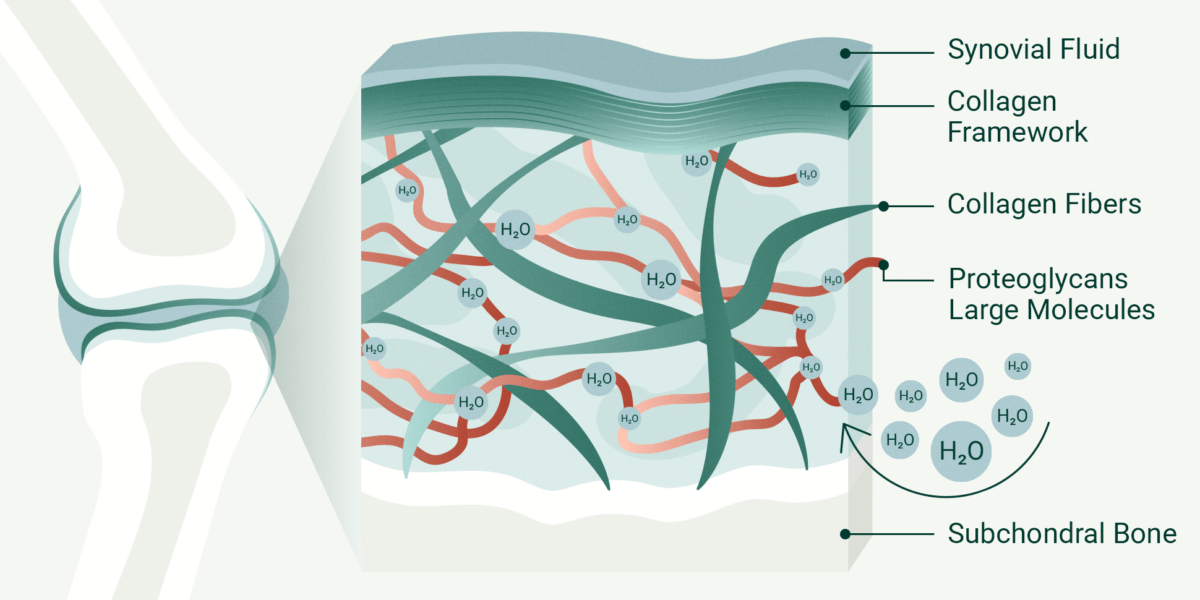
When you step down or squat, that water gets compressed and spread out across the joint surface. When you stand back up, the cartilage rebounds and draws fluid back in.
That compression-and-release cycle is how your knee cushions force and keeps movement smooth.
There’s also synovial fluid, the slippery liquid inside the joint capsule. It reduces friction and helps nourish cartilage, which doesn’t have its own blood supply3. Every time you move your knee, you’re essentially pumping that fluid around.
When everything is working properly:
- Cartilage stays hydrated.
- Fluid circulates efficiently.
- Friction remains extremely low.
But when hydration drops, structure weakens, or inflammation lingers, the system becomes less efficient.
- Cartilage doesn’t rebound quite as quickly.
- Fluid exchange slows.
- Load becomes more concentrated instead of evenly distributed.
And that’s when everyday movements start to feel different.
Can You “Lubricate” Your Joints?
It’s a common question.
“How do I lubricate my knees?”
“Is there something I can take to add lubrication?”
The idea makes sense. If a hinge squeaks, you oil it. If your knees feel stiff, you assume they just need more lubricant.
But joints don’t work like door hinges. And you can’t pour lubrication into your knee. In fact, you don’t need to! That’s because your body produces its own lubricant: synovial fluid. And that fluid is constantly being recycled, circulated, and refreshed through movement.
Every time you bend and straighten your knee, you’re pumping fluid through the joint. That movement helps deliver nutrients to cartilage and remove waste products.
So lubrication depends on three things:
- Healthy cartilage that can hold water and maintain its structure
- Efficient synovial fluid circulation
- Balanced inflammatory signaling that doesn’t thicken or degrade that fluid
⇒ When cartilage loses hydration, it becomes less springy under pressure. Instead of compressing and rebounding smoothly, it stiffens — so force gets concentrated rather than evenly distributed.
⇒ When movement decreases, synovial fluid doesn’t circulate as efficiently. Nutrient delivery slows, waste products accumulate, and the joint can feel tight when you first start moving again.
⇒ When inflammation lingers, the joint environment becomes more sensitive. Fluid can thicken slightly, tissues become more reactive under load, and normal compression starts to feel uncomfortable.
That’s why stiffness often feels worse after sitting for a long time. The joint hasn’t been moving. Fluid exchange slows. The first few steps feel tight. Then things gradually loosen up.
So “lubricating your joints” isn’t about adding oil.
It’s about restoring the biology that keeps cartilage hydrated, fluid circulating, and inflammation resolving properly.
And that brings us to another common question…
What Causes Sudden Knee Pain?
One of the most confusing experiences is this:
Your knee suddenly starts hurting. And you can’t point to a single thing that caused it. No twist, no fall, no awkward landing during a workout. It just… appeared.
In many cases, this kind of sudden-onset knee pain without trauma isn’t from a torn ligament, fractured bone, or major structural damage. It’s often a temporary (or sometimes building) shift in the delicate balance inside the joint environment itself. Everyday life throws subtle stressors at your knees constantly, and when a few align just right, the joint “protests” in a way that feels abrupt and alarming.
Here’s a few common lifestyle triggers:
- You increase activity. Walking more steps than usual, standing longer, climbing extra stairs, or even taking a new exercise class.
- Prolonged sitting. Think long drives, desk days, or binge-watching, which slows synovial fluid circulation and lets minor irritants build up.
- Extra stress. This ramps up low-grade systemic inflammation. And can make joint tissues more sensitive to normal compression forces.
- Cartilage breakdown. Cartilage is always in a dynamic state of breakdown and repair. If repair lags even briefly, due to nutrition, age-related slowdown, or repetitive micro-stress, breakdown markers can rise enough to make the joint feel “off” under load, even without a dramatic event.
- Muscle fatigue or temporary imbalances in the quads, hamstrings, glutes, or calves. When these supporting muscles tire faster or don’t recover as quickly (from a tough day, dehydration, or skipped warm-ups), they absorb less force. More load shifts directly onto the cartilage and joint surfaces, amplifying pressure where it hurts most.
These aren’t usually signs of something catastrophically broken. They signal the joint’s internal balance… between inflammation resolution, cartilage resilience, muscle support, and fluid dynamics… has been temporarily disrupted. Under the high-compression demands of bending, squatting, or stepping down (where forces can hit 3–8 times body weight), even small imbalances get magnified into real pain.
That’s actually encouraging news.
Because if the root isn’t acute structural injury, the approach shifts from “protect and rest indefinitely” to “restore balance and support the biology.”
Gentle movement, targeted nutrition, better recovery habits, and ingredients that address these exact layers (inflammation, cartilage protection, muscle resilience) often help calm things faster and more completely than waiting it out alone.
Of course, if the pain is severe, comes with fever/redness/swelling, locks the knee, or persists/worsens, see a doctor to rule out rarer issues like infection, gout flare, or septic arthritis. But for the vast majority of “out-of-nowhere” knee flares, understanding these biological triggers points the way toward real relief.
That brings us to the practical part: What actually helps rebalance the knee environment so sudden pain fades and smoother, more confident movement returns?
What actually helps calm knee pain and restore smoother movement?
What Helps Knee Pain?
If knee pain often reflects compression exposing imbalance inside the joint, then relief isn’t just about resting or numbing the sensation.
It’s about improving how the joint handles load. And that means addressing three core areas.
1. Calm Lingering Inflammation
Inflammation is necessary for repair. But when it lingers longer than it should, tissues become more sensitive under pressure. Supporting proper inflammatory resolution helps reduce that background sensitivity. When inflammatory signaling normalizes, everyday compression doesn’t feel as amplified.
This is where ingredients like highly bioavailable curcumin can make a difference. Not by shutting inflammation down completely, but by helping restore its normal on-and-off rhythm.
2. Restore Cartilage Cushioning
Cartilage protects the knee by holding water and distributing force evenly. When hydration drops or breakdown slightly outpaces repair, cushioning declines. Pressure becomes more concentrated. Movement feels rougher.
Supporting cartilage structure helps restore how force is absorbed and spread across the joint surface. When cushioning improves, compression feels smoother instead of sharp or resistant.
3. Improve Muscle Recovery
Strong muscles protect the knees. When quads, hamstrings, and glutes resist fatigue and recover efficiently, they absorb more load before it ever reaches cartilage. But when muscles tire easily or stay in a stressed state longer, more force transfers directly into the joint4.
Supporting muscle recovery and reducing oxidative stress helps maintain stability under load. Especially during stairs, squats, and running.
When these three layers are supported together:
• Inflammatory sensitivity decreases
• Cartilage handles pressure more effectively
• Muscles absorb and distribute force more reliably
The same movements that once triggered discomfort begin to feel manageable again. Not because you stopped using your knees. But because your knees are functioning closer to the way they were designed to.
And that’s why we formulated our upcoming AlgaeCal Restore™ the way we did.
Why We Built AlgaeCal Restore™ This Way
If knee pain is often the result of load exposing small imbalances inside the joint, then any real solution has to address more than one layer.
Calming inflammation alone isn’t enough.
Supporting cartilage structure alone isn’t enough.
Improving muscle recovery alone isn’t enough.
Knees function as a system. So we built AlgaeCal Restore™ as a system.
- Theracurmin® supports healthy inflammatory resolution, helping reduce the background sensitivity that makes compression feel amplified.*‡
- Move3® supports cartilage integrity at the structural level, including measurable reductions in markers of collagen breakdown under load.*‡
- AstaReal® Astaxanthin supports muscle recovery and resilience, helping the muscles around the knee absorb more force before it ever reaches joint surfaces.*‡
Each ingredient targets a different stressor inside the knee. And together, they support how the joint handles load.
That’s the difference.
We didn’t design AlgaeCal Restore™ to temporarily mask discomfort. We designed it to support the biology that determines whether squats, stairs, and long walks feel smooth — or punishing.
And it comes with an incredible guarantee.
Better Joints. Or it’s FREE.™
Most supplement guarantees are based on how you feel. Ours is based on what’s actually happening inside your joints.
It’s called Better Joints. Or it’s FREE.™
Here’s how it works.
Get a baseline WOMAC score.
Before starting AlgaeCal Restore™, complete a WOMAC assessment within the 30 days leading up to your start date. This simple test measures joint discomfort, stiffness, and physical function in your knees and hips. Ask your doctor or physiotherapist to administer the test and keep a copy of your score for comparison later.
Take AlgaeCal Restore™ daily for 90 days.
Use as directed, every day, for a full 90 days so it has a fair chance to support your cartilage, joint comfort, and mobility.
Complete the WOMAC assessment again.
After 90 days, repeat the WOMAC assessment. If your WOMAC score hasn’t improved (a lower score indicates better comfort and function), we’ll refund your purchase.
So there’s nothing to lose. Either your knee and hip comfort improves or your money back.
Coming Soon
Joint Support That Goes Beyond Temporary Relief.
Most joint products try to manage discomfort for a little while. AlgaeCal Restore™ was built to do more. The key ingredients help address the underlying drivers of joint pain and stiffness by supporting cartilage, a healthy inflammation response, and muscle recovery around the joint*‡.
Here’s what that looks like in real people*‡:
- 67% less knee pain compared with placebo in just 8 weeks.5
- Measurable reductions in activity-related joint pain in 1–2 weeks.6
- 28.6% less stiffness within 2 weeks.7
- 17.7% less cartilage breakdown in just 14 days, based on a key biomarker linked to cartilage wear.8
- Nearly 30% improvement in joint function within 6 months.9
- Reduced reliance on nonsteroidal anti-inflammatory drugs (NSAIDs) within 8 weeks.10
That’s the difference between a formula designed to “help you cope,” and one designed to support healthier joints from the inside out.
Why join the priority list?
We’ve prepared carefully for the launch of AlgaeCal Restore™. But because this is a brand-new formula made with clinically supported ingredients sourced from leading innovators in places like Japan and Sweden, we expect strong demand early on.
That’s why we created this priority list.
Join now, and we’ll send you your 20% OFF† discount code before AlgaeCal Restore™ goes on sale to the public in October, so you can order early.
‡Results consistent with Clinical Trials on Individual Ingredients.
†Terms Apply



Sharon Karen Donohue
October 6, 2026 , 12:45 pmYes I am very interested