



An evidence-based breakdown of muscle damage, oxidative stress, and what to take to support real recovery.
You finish a workout feeling good.
You pushed hard. You moved well. Maybe you even felt strong.
Then the next morning hits…
Your legs feel heavy walking down stairs. Your chest feels tight. Your quads remind you of those squats you did two days ago.
What you’re feeling is the downstream effect of controlled muscle damage and how efficiently your body handles the recovery process afterward.
Every time you train, lift, run, hike, or even do high-rep bodyweight work, you create microscopic stress inside muscle fibers. That’s not a bad thing. In fact, it’s the stimulus that drives adaptation.
But here’s the part most people ignore…
Muscle recovery isn’t just about rebuilding tissue.
It’s about managing inflammation, clearing oxidative stress, restoring cellular energy systems, and resetting your neuromuscular efficiency so you’re ready to perform again.
If any part of that process lags, even slightly, soreness lasts longer, fatigue accumulates faster, and performance dips.
And over time, that doesn’t just affect how you feel.
It affects how often you train. How hard you push. And how much load your joints are forced to absorb when muscles don’t fully rebound.
Understanding why soreness lingers is the first step to fixing it.
And it starts at the cellular level.
What Actually Happens Inside Your Muscles After a Workout
When you train, especially under load, muscle fibers experience microscopic structural disruption.
This is often called “microtearing,” but that term oversimplifies it.
What’s really happening is this:
- Contractile proteins (actin and myosin) experience mechanical strain.
- The surrounding cell membranes become temporarily destabilized.
- Calcium balance inside the muscle fiber shifts.
- Mitochondria ramp up energy production to meet demand.
That surge in energy production creates something unavoidable:
Reactive oxygen species (ROS).
ROS are not inherently bad. In fact, they act as signaling molecules that tell the body to adapt and rebuild stronger. But the problem arises when ROS production exceeds your antioxidant defense capacity.
That imbalance is called oxidative stress.
When oxidative stress accumulates, it can:
- Damage muscle cell membranes
- Disrupt mitochondrial efficiency
- Increase creatine kinase (CK), a marker of muscle fiber damage
- Prolong inflammatory signaling
- Delay the restoration of contractile strength
This is why soreness peaks 24 to 72 hours after training. Because cellular cleanup, membrane repair, and protein rebuilding are still underway.
In a younger or well-supported system, recovery tends to be efficient. Reactive oxygen species rise during training, antioxidant systems neutralize the excess, inflammation switches on and then resolves, and muscle fibers repair in a timely way. Within a day or two, strength returns and the system resets.
But over time, that precision starts to soften.
Antioxidant capacity gradually declines. Sleep may not be as deep or restorative. Training volume stays high while recovery capacity drops. Nutritional gaps become more meaningful than they used to be.
Now the same workout generates more oxidative stress than the body can clear quickly. Inflammatory signaling lingers a little longer. Muscle fibers take more time to regain full contractile strength. Nothing dramatic. Nothing alarming. Just slower resolution.
And when recovery slows, soreness hangs on longer than it should. Performance feels slightly muted. The next training session begins before the previous one has fully resolved.
That is how fatigue accumulates. Not from one hard workout, but from a recovery system that no longer resets as efficiently as it once did.
That’s the bottleneck most people never address. They focus on protein. They stretch. They foam roll. But they ignore the cellular stress that determines how fast the system resets.
And that’s where targeted support starts to matter…

What Speeds Up Muscle Recovery
If post-workout soreness comes from micro-damage and lingering cellular stress, then relief isn’t about dulling the sensation. It’s about improving how quickly your body repairs and resets itself.
There are four pillars that determine how quickly you bounce back after a workout:
1. Eat More Protein
A 2022 landmark systematic review1 of 74 randomized controlled trials, involving 2,665 healthy adults across a wide age range, examined protein supplementation alongside resistance training.
The conclusion was clear:
Daily protein intakes in the range of 0.55 to 0.73 grams per pound of body weight significantly support muscle protein synthesis. That’s the biological process responsible for repairing and rebuilding muscle fibers after training.
Across the analyzed studies, higher protein intake combined with resistance training led to measurable increases in lean body mass and improvements in lower-body strength compared to training alone.
From a recovery standpoint, that matters.
More dietary protein means the body shifts more efficiently from net breakdown toward net rebuilding. Without adequate intake, recovery simply cannot run at full capacity. So, if you’re under-eating protein, you’re limiting your ability to repair.
2. Get More Sleep
If protein provides the raw materials for repair, sleep determines how effectively those materials get used. A 2021 scientific review2 published in the Journal of Science and Medicine in Sport examined how sleep influences recovery from exercise-induced muscle damage. The researchers analyzed evidence on hormonal regulation, immune signaling, and tissue repair following training stress.
Their conclusion was clear.
Deep sleep plays a central role in muscle recovery. That’s because it regulates growth hormone (GH) and insulin-like growth factor 1 (IGF-1), two key anabolic signals responsible for driving tissue repair and regeneration. It also helps coordinate the immune response required to move muscle tissue through its repair phases: degeneration, inflammation resolution, regeneration, and remodeling.
When sleep is restricted, that process is disrupted.
Sleep deprivation has been shown to elevate pro-inflammatory cytokines such as IL-6 and TNF-α, prolong inflammatory signaling, blunt anabolic hormone responses, and delay tissue repair. In practical terms, this translates to slower strength restoration, increased soreness, and higher injury risk over time.
On the other hand, extending sleep improves pain sensitivity thresholds, enhances anabolic hormone profiles, and supports faster recovery following muscle damage.
From a recovery standpoint, this is not a minor variable.
You can train hard and eat well, but if sleep is compromised, the hormonal and immune systems that coordinate muscle repair cannot operate efficiently.
3. Respect Recovery Capacity
There’s another variable most people underestimate:
Recovery capacity is finite.
A highly cited 2012 review3 published in Sports Health examined overtraining syndrome and the biochemical mechanisms behind performance decline. The authors synthesized both clinical and laboratory research to explain what happens when training load consistently exceeds recovery ability.
The findings were clear.
When training stress is chronically high without adequate rest, oxidative stress markers remain elevated even at rest. Lipid peroxidation products and protein carbonyls increase, indicating ongoing cellular damage. With each additional workout, reactive oxygen species spike further because antioxidant systems cannot keep pace.
In overtrained athletes, this imbalance becomes measurable.
Resting oxidative stress is higher than normal. Acute exercise exaggerates it further. And antioxidant defenses struggle to neutralize the load, allowing reactive oxygen species to accumulate faster than they can be cleared.
The downstream effects are predictable.
- Persistent fatigue.
- Delayed muscle recovery.
- Prolonged inflammation.
- Declining performance despite continued effort.
Importantly, this does not require extreme training volumes. The imbalance can occur gradually when output consistently exceeds repair capacity.
From a recovery perspective, the lesson is simple:
If oxidative stress accumulates faster than your system can resolve it, soreness lasts longer, and adaptation slows.
In other words…
Training builds strength, but only if recovery keeps pace. When it doesn’t, oxidative stress becomes the limiting factor.
4. Support Antioxidant Capacity
Every workout creates oxidative stress. That’s normal. It’s part of how your body produces energy and adapts to effort. But the problem happens when that oxidative stress builds faster than your body can clean it up.
That’s when recovery starts to feel “expensive.”
You can still do the hike.
You can still do the garden.
You can still do the workout.
But you pay for it later. Stiff the next morning. Heavy legs. A lingering soreness that hangs around longer than it should. When that pattern repeats, it usually points to one thing: oxidative stress is accumulating faster than it’s being cleared.
And if oxidative stress is part of the bottleneck, then supporting the body’s antioxidant defenses becomes a logical next step.
This is where astaxanthin becomes interesting. Because it helps regulate the oxidative load that determines how efficiently muscle tissue resets after training.
Astaxanthin is a carotenoid antioxidant sourced from microalgae.
What makes it clinically interesting is where it goes.
Rather than staying mostly in circulation, astaxanthin integrates into cell membranes, including:
- Muscle cell membranes (where exercise damage starts)
- Mitochondria (where energy demand creates reactive oxygen species)
- Blood vessel tissue (which influences oxygen and nutrient delivery)
By positioning itself at these high-stress sites, astaxanthin supports how efficiently muscle tissue recovers after intense effort. Studies consistently highlight outcomes that matter in real life: delayed fatigue onset, longer work capacity under load, reduced muscle damage from the same intensity, and faster recovery between sessions.
In practical terms, that means it helps stabilize the exact structures that oxidative stress disrupts during training.
But not all astaxanthin is created equal.
AstaReal® For Muscle Recovery
The specific form of astaxanthin, AstaReal®, has been examined in more than 80 clinical studies, many using low daily doses of just 4–6 mg.
And those studies focused on the outcomes that actually matter in real life:
• How long muscles can keep working under load
• How quickly fatigue sets in
• How much cellular damage follows effort
• How fast recovery happens afterward
Together, those factors decide something very important…
Can you keep doing the things you love, without “paying for it” the next day?
In a six-month, double-blind, placebo-controlled study published in the prestigious journal Carotenoid Science4, researchers asked a simple question:
Can AstaReal® help ordinary people hold onto muscle endurance over time?
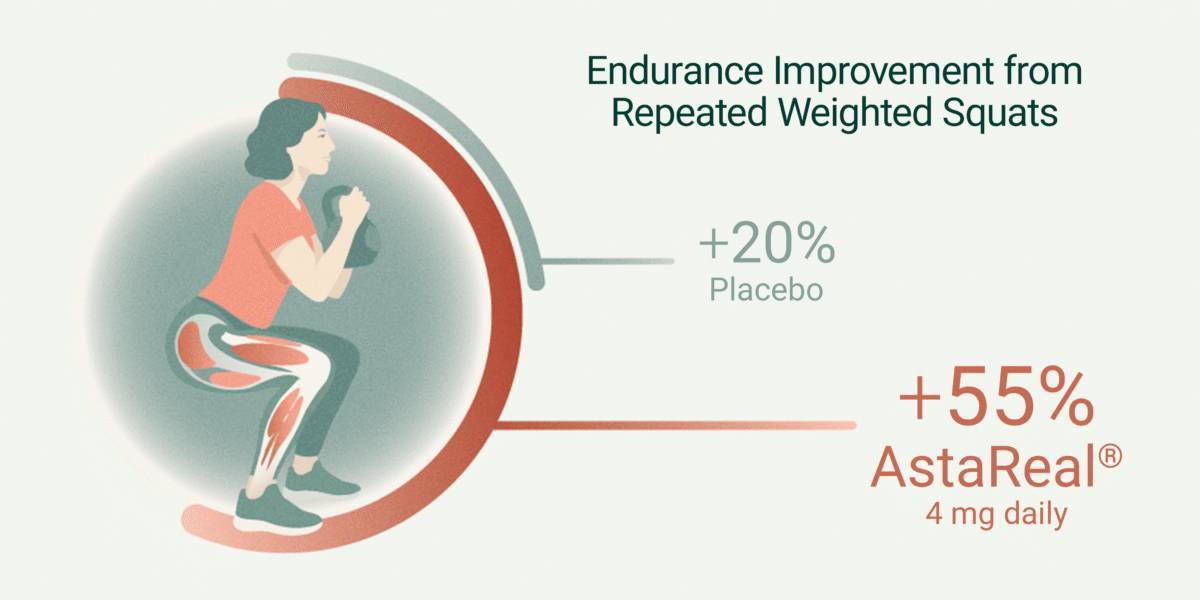
So they recruited 40 healthy, physically active adults and gave them a daily dose of either 4 mg of AstaReal® or a placebo.
To test endurance, researchers used repeated weighted squats — a simple, unforgiving measure of how long your muscles can keep working under load.
If you’ve ever done a set properly, you know the moment it happens…
Your legs start to burn.
Your form wants to break.
And willpower alone isn’t enough to squeeze out another rep.
By month six, the separation was clear. The AstaReal® group improved squat endurance by about 55%. The placebo group improved by about 20%*‡.
That’s nearly a three-fold difference!
And nothing else changed.
No new training plan.
No added workouts.
No motivational speeches.
Which tells you something important.
The improvement didn’t come from trying harder. It came from muscles that resisted fatigue longer and recovered more efficiently between efforts.
In another randomized, double-blind, placebo-controlled study published in the Journal of Sports Medicine and Physical Fitness5, researchers followed elite youth players from Red Star Belgrade — one of Europe’s top soccer academies.
For 90 days, they took either 4 mg/day of AstaReal® or a placebo. Training didn’t change.
After a full competitive match, researchers measured creatine kinase — a key marker of muscle damage.
The result?
Muscle damage rose 44% less in the AstaReal® group*‡.
That’s not a small margin. That’s the difference between muscle that’s stressed, and muscle that’s breaking down.
But there’s more to recovery than muscles alone…
Recovery Doesn’t Stop at Muscle
Muscle recovery isn’t isolated. When muscles recover efficiently, they do more than feel better.
They stabilize movement.
They absorb force.
They protect connective tissue.
When they don’t…
Load shifts. Tension redistributes. And joints begin carrying more stress than they were designed to.
That’s why muscle recovery and joint resilience are linked.
Not because they’re the same thing. But because they depend on each other. Supporting oxidative resilience with AstaReal® addresses one side of that equation.
But long-term recovery also depends on:
Balanced inflammatory signaling.
Healthy cartilage turnover.
Efficient nutrient delivery.
Which is why our upcoming product AlgaeCal Restore™ wasn’t built around a single mechanism.
It was built around recovery as a system.
Why AlgaeCal Restore™ Is Different
AlgaeCal Restore™ combines clinically supported ingredients chosen to support the processes that determine how you feel after activity, not just in your muscles, but in the whole movement system that depends on them.
It includes:
AstaReal® to support oxidative recovery and reduce the buildup that makes soreness linger*‡.
Move3® (NEM® + Fish Oil) to support cartilage turnover and help joints handle repeated load more comfortably*‡.
Highly bioavailable Theracurmin® to support a healthy inflammatory response, so the “off switch” works the way it’s supposed to*‡.
AlgaeCal Absorb™ to support nutrient delivery, because ingredients only matter if your body can use them.
Across the published human studies on these individual ingredients, researchers observed outcomes that match what you’d expect when recovery systems are actually improving.
Coming Soon. AlgaeCal Restore™
Support That Goes Beyond Temporary Relief.
Most joint and muscle products try to manage discomfort for a little while. But our newest product, AlgaeCal Restore™, was built to do more. The key ingredients help address the underlying drivers of pain and stiffness by supporting cartilage, a healthy inflammation response, and muscle recovery around the joint*‡.
Here’s what that looks like in real people:
- 44% less muscle damage after physical activity 6*‡
- 67% less knee pain compared with placebo in just 8 weeks.7*‡
- Measurable reductions in activity-related joint pain in 1–2 weeks.8*‡
- 28.6% less stiffness within 2 weeks.9*‡
- 17.7% less cartilage breakdown in just 14 days, based on a key biomarker linked to cartilage wear.10*‡
- Nearly 30% improvement in joint function within 6 months.11*‡
- Reduced reliance on nonsteroidal anti-inflammatory drugs (NSAIDs) within 8 weeks.12*‡
That’s the difference between a formula designed to “help you cope,” and one designed to support healthier joints from the inside out.
Why join the priority list?
We’ve prepared carefully for the launch of AlgaeCal Restore™. But because this is a brand-new formula made with clinically supported ingredients developed in places like Japan and Sweden, we expect strong demand early on.
That’s why we created a priority list.
Join now and we’ll send you your 20% OFF† discount code before AlgaeCal Restore™ goes on sale to the public in October, so you can order early.
‡Results consistent with Clinical Trials on Individual Ingredients.
†Terms Apply

Article Comments