



The surprising role exercise plays in nourishing cartilage and delivering real, lasting relief (backed by landmark studies).
If your joints have started feeling stiff, achy, or unreliable, the first advice you’ll usually hear is:
“Change your diet.”
And that’s not wrong. What you eat influences inflammation. And inflammation plays a major role in how your joints feel. That’s why an anti-inflammatory diet is a great place to start.
But you can’t just eat your way to healthier joints. It’s not that simple!
That’s because while food shapes the inflammatory environment around your joints, it doesn’t strengthen the joints themselves.
For that, you need exercise.
Simply put:
Food works indirectly.
Exercise works directly.
And long-term joint health depends on both.
Let’s break that down…
How an Anti-Inflammatory Diet Helps Your Joints
When we talk about an anti-inflammatory diet, we’re really talking about lowering your body’s overall inflammatory load.
Throughout the day, your body naturally produces small amounts of inflammatory chemicals. And that’s a good thing! It’s part of your body’s built-in repair system.
If you cut your finger, inflammation helps stop bleeding and begin healing.
If you strain a muscle, inflammation brings cells to repair the tissue.
If bacteria enter your body, inflammation helps fight them off.
It’s protective.
So the problem isn’t inflammation itself. The problem is when the body’s inflammatory signals stay slightly elevated for too long.
Think of it like hiring a contractor to repair your house…
When something breaks, you want them there.
They fix what needs fixing.
They patch the damage.
They reinforce the weak spots.
And then they leave.
The problem starts when the contractor doesn’t leave. Imagine the drilling and hammering continuing long after the repair is finished. Day after day. Room after room.
At some point, the “repair work” becomes disruptive.
That’s what low-grade chronic inflammation looks like inside the body.
It’s a repair system that never fully switches off. And over time, that constant background activity begins to wear on tissues — including your joints.
And certain eating patterns make that more likely.
For example, a study1 published in the journal of the American Heart Association, found that even in healthy adults, a single blood sugar spike from a can of soda or a plate of pasta can raise inflammatory biomarkers for as much as 2 hours.
While another study2 published in the American Journal of Clinical Nutrition, found that diets high in omega-6–rich processed fats and low in omega-3s were associated with higher levels of inflammatory markers in the blood. In other words, when the balance of fats shifts too far toward processed oils and away from healthy omega-3s, the body tends to stay in a more inflammatory state.
None of this causes instant pain.
You won’t feel it after one soda.
You won’t notice it after one takeout meal.
But biology accumulates. And over months and years, it changes your body’s inflammatory environment.
And joints are particularly sensitive to that environment.
Cartilage doesn’t have a rich, direct blood supply like muscle. It depends on the surrounding fluid and tissues for nutrients and recovery. So when background inflammation remains even modestly elevated, it irritates the joint.
That’s where an anti-inflammatory diet comes in…
In a 2020 clinical study3 published in The American Journal of Clinical Nutrition, researchers tested what happens when people with rheumatoid arthritis switch to an anti-inflammatory diet.
The study used what’s called a randomized crossover design. That simply means the same participants followed two different diets at different times — first one plan, then the other — so researchers could directly compare the effects within the same individuals.
Fifty participants rotated between two 10-week eating patterns:
1- An anti-inflammatory diet
2- A typical Western diet
Among the 29 participants who closely followed both plans, the anti-inflammatory diet significantly lowered levels of ESR.
ESR stands for erythrocyte sedimentation rate. It’s a simple blood test doctors use to measure overall inflammation in the body. Higher ESR means more systemic inflammation. Lower ESR means less.
The takeaway?
An anti-inflammatory diet measurably lowers the background inflammation your joints are exposed to, which makes recovery easier and daily mechanical stress less disruptive.
Which is great! However, lowering inflammation is not the same as building strength.
That comes from something else…
How Exercise Strengthens Your Joints
If diet lowers background inflammation, exercise does something different.
It feeds the joint.
Cartilage is an unusual tissue. Unlike muscle, it has no direct blood supply. That means nutrients do not arrive through capillaries. They arrive through movement.
When a joint is loaded, during walking, squatting, or climbing stairs, cartilage is gently compressed. When the load is removed, it rebounds. That compression-and-release cycle drives fluid in and out of the tissue.
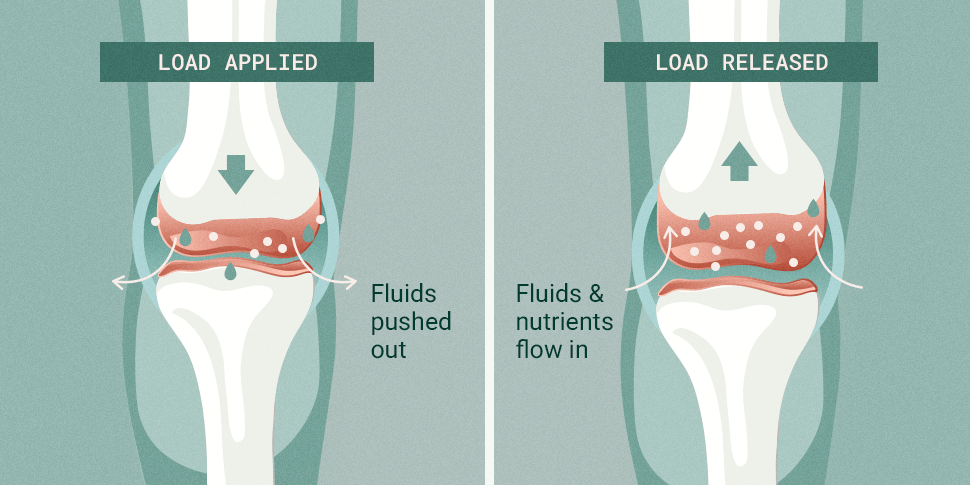
And that fluid carries nutrients.
In a foundational study4 published in Annals of the Rheumatic Diseases, researchers tested what happens to human cartilage when it is gently compressed and released. They found that this repeated compression dramatically improved the movement of nutrients through the cartilage. In fact, the flow of larger nutrient molecules increased by 30–100% compared to cartilage that wasn’t being loaded at all.
In other words…
When cartilage is regularly compressed and released, nutrient exchange improves dramatically.
Later imaging studies5 confirmed the same pattern in living joints. MRI research summarized in the Journal of Anatomy showed that cartilage temporarily deforms under pressure… fluid is pushed out… and then draws fresh fluid back in when pressure is removed.
Over time, moderate, consistent loading was associated with maintained, and in some cases slightly increased, cartilage thickness in healthy individuals.
By contrast, reduced loading and immobilization led to thinning. This becomes even more important for people worried about joint wear.
A large systematic review6 in the British Journal of Sports Medicine examined whether exercise “wears down” knee cartilage in people with or at risk for osteoarthritis. Across nine randomized controlled trials, involving a total of 702 participants (with a mean age of around 50–65 years), researchers found no evidence of cartilage damage from appropriately prescribed exercise. In fact, in some cases, cartilage health actually showed signs of improvement.
Your joints are living tissue.
They require movement to stay nourished, resilient, and structurally sound.
Joints Need Both Diet & Exercise
An anti-inflammatory diet lowers the low-grade chronic inflammation that irritates joints over time. Exercise does something else entirely. Through repeated compression and release, it circulates fluid through the cartilage, pumping in nutrients and helping the tissue maintain its strength.
One improves the environment around the joint.
The other strengthens the joint itself.
But the real magic happens when the two are combined.
We see this clearly in a landmark study7 published in The Journal of the American Medical Association, one of the most respected medical journals in the world.
Researchers followed 454 overweight adults with knee osteoarthritis for 18 months. Participants were assigned to one of three groups: diet alone, exercise alone, or a combination of both.
One of the most important findings involved inflammation.
Researchers measured levels of IL-6, a pro-inflammatory protein circulating in the bloodstream. Higher IL-6 levels are linked to greater joint pain and cartilage stress.
Lower levels indicate a calmer inflammatory environment.
After 18 months, the diet group showed significantly reduced IL-6 compared to the exercise group.
The exercise group, however, improved joint function and mobility despite smaller changes in IL-6.
But the combined group had better clinical outcomes than both!
The biology is straightforward.
Diet reduces inflammatory pressure on the joint. Exercise improves how the joint tolerates load.
Address both, and you improve the conditions around the joint and the strength within it.
The Best Anti-Inflammatory Diet & Exercise Routine for Joint Health
If you’re looking for a simple, evidence-based routine to support your joints long-term, here’s what the research consistently supports.
Step 1: Build an Anti-Inflammatory Plate
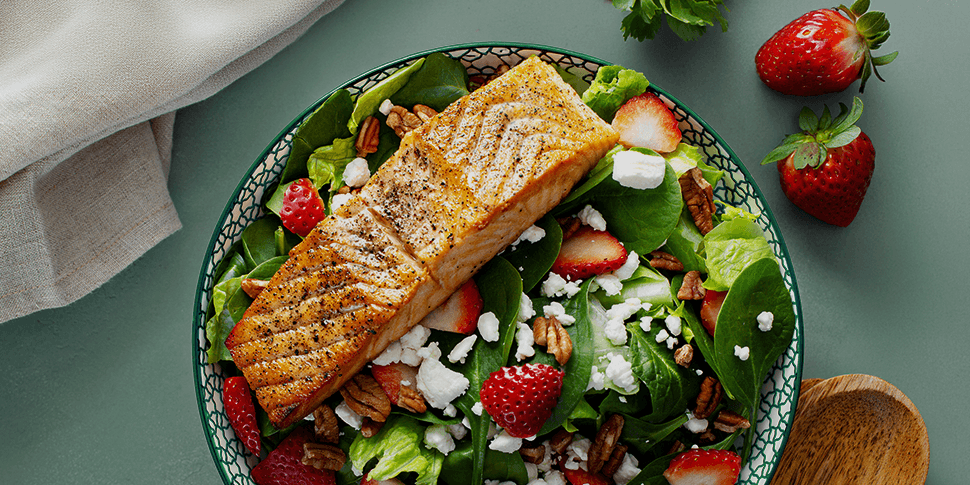
Focus on foods that lower systemic inflammation and support metabolic stability:
Core anti-inflammatory foods:
- Fatty fish (salmon, sardines, mackerel) – rich in omega-3s
- Extra virgin olive oil
- Berries (blueberries, strawberries)
- Leafy greens (spinach, kale, arugula)
- Nuts (especially walnuts and almonds)
- Legumes
- Whole grains (oats, quinoa)
- Colorful vegetables (peppers, broccoli, carrots)
Limit:
- Refined carbohydrates (white bread, pastries, soda)
- Processed seed oils high in omega-6 (excess corn, soybean, sunflower oil)
- Ultra-processed packaged foods
Step 2: Add Low-Impact Joint Exercises

Cartilage thrives on controlled loading. The most joint-friendly options include:
- Brisk walking
- Cycling
- Swimming or water aerobics
- Bodyweight squats
- Step-ups
- Resistance band exercises
- Light strength training (especially for hips and thighs)
These movements create the compression-and-release cycle that pumps nutrients into cartilage without excessive joint stress.
Aim for:
- 3 sessions per week of strength work
- 20–30 minutes of low-impact cardio most days
- Consistency over intensity
Step 3: Combine Both
An anti-inflammatory diet lowers the biological stress inside the joint. Whereas exercise uses that improved environment to build strength and resilience.
If inflammation stays high, recovery slows. If loading is absent, cartilage thins.
Together, diet and movement create a stable environment and mechanical stimulus, which is what joints require long-term.
Where Lifestyle Alone Has Limits
Diet lowers inflammatory pressure. Exercise strengthens the joint’s mechanical resilience. But even when both are in place, certain biological processes are still difficult to influence through food and movement alone.
Cartilage turnover slows with age.
Oxidative stress accumulates over time.
Joint tissues don’t regenerate quickly, even in ideal conditions.
That’s not a failure of lifestyle.
It’s simply biology.
And this is where targeted nutritional support can become relevant.
Because if you understand the mechanisms driving joint decline –– inflammation, cartilage breakdown, oxidative stress, reduced recovery — the next logical question becomes:
Is there a way to support those processes more directly?
That’s where clinically supported ingredients enter the conversation.
And it’s exactly why we developed AlgaeCal Restore™.
Coming Soon
Joint Support That Goes Beyond Temporary Relief.

Most joint products try to manage discomfort for a little while. AlgaeCal Restore™ was built to do more. The key ingredients help address the underlying drivers of joint pain and stiffness by supporting cartilage, a healthy inflammation response, and muscle recovery around the joint*‡.
Here’s what that looks like in real people*‡:
- 67% less knee pain compared with placebo in just 8 weeks.8
- Measurable reductions in activity-related joint pain in 1–2 weeks.9
- 28.6% less stiffness within 2 weeks.10
- 17.7% less cartilage breakdown in just 14 days, based on a key biomarker linked to cartilage wear.11
- Nearly 30% improvement in joint function within 6 months.12
- Reduced reliance on nonsteroidal anti-inflammatory drugs (NSAIDs) within 8 weeks.13
Why join the priority list?
We’ve prepared carefully for the launch of AlgaeCal Restore™. But because this is a brand-new formula made with clinically supported ingredients sourced from leading innovators in places like Japan and Sweden, we expect strong demand early on.
That’s why we created this priority list.
Join now, and we’ll send you your 20% OFF† discount code before AlgaeCal Restore™ goes on sale to the public in October, so you can order early.
‡Results consistent with Clinical Trials on Individual Ingredients.
†Terms Apply



Marian Sammartino Miskell
September 22, 2026 , 11:01 amwhat are the Ingredients in Restore?